Every few months, a fresh demo makes the rounds. An agent gets one vague prompt, thinks for a while, and by the end of the video it has apparently shipped a full feature to production. No humans, no gates, no drama.
If you have actually tried to run agents unattended against a real enterprise codebase, you know how that story usually ends. Somewhere around step twelve, the model quietly assumes the wrong version of an internal API, keeps building on top of that assumption, and forty minutes later you are staring at a very confident, very broken pull request.
The uncomfortable truth is that "full autonomy" is mostly a marketing pitch. What actually works in production is a lot less glamorous: agents that pause, check in, and let engineers steer at the moments that matter. I have started calling this collaboration-in-the-loop, and I think it is the pattern the next generation of AI tooling will be judged on.
Why unsupervised agents fall apart
The problem is not that models are dumb. Modern reasoning models are remarkable. The problem is that agent runs are sequential, and every step is conditioned on the last one.
Miss a small assumption on step two, and by step fifteen you are not debugging code, you are debugging a hallucinated worldview.
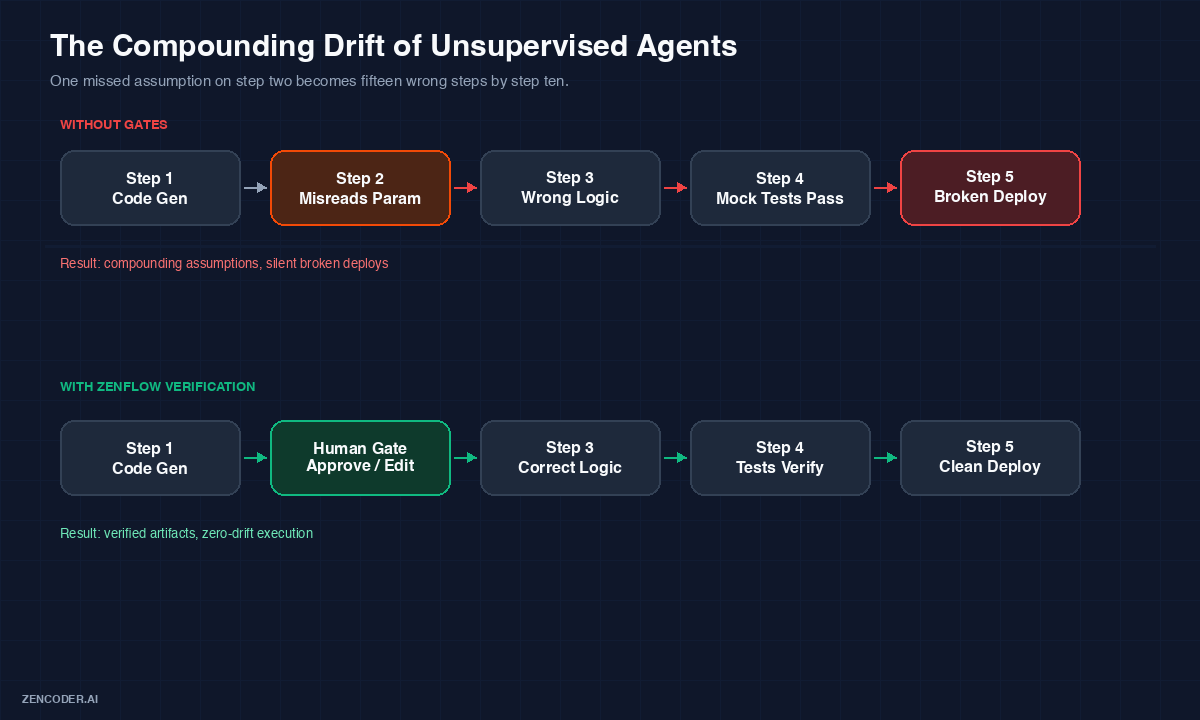
Without a human gate, a single misread parameter on step two compounds into a broken deployment. With Zenflow verification, each step is checkpointed before it moves forward.
In practice, three failure modes keep showing up when we let agents run wide open:
- Contextual blindness. The model can read your code, but it does not know that the "legacy" module is legacy for a reason, or that a specific team owns a specific endpoint. That kind of tribal knowledge lives in Slack threads and postmortems, not in the repo.
- Expensive loops. When an agent hits a stubborn error, it often tries the same three fixes on repeat, burning tokens with each pass. Nobody notices until the bill arrives.
- Compliance friction. SOC 2 and ISO 27001 are not going to accept "the agent decided to deploy." Separation of duties is not optional in most enterprise environments.
None of this means agents are useless. It means the "one prompt, one production release" fantasy needs to die.
What collaboration-in-the-loop actually looks like
The mental model I keep coming back to is this: treat the agent like a strong, fast junior engineer. Brilliant at typing, questionable at judgment, and much better when they check in at the right moments.
Three things make this pattern work in real teams:
1. Milestones with gates. Break the work into phases, planning, implementation, review, and require the agent to hand off a real artifact at the end of each one. If nothing changes on disk, nothing moved forward. If something did change, a human or a second system decides whether it moves to the next phase.
2. A second opinion built in. Before an engineer even opens the diff, another model with a different system prompt takes a pass at it. The reviewer is not trying to be nice, it is looking for regressions, security holes, and lazy shortcuts. Two independent models rarely make the same mistake twice.
3. A workspace that is not yours. Agents should never edit the branch you are actively working in. Isolated git worktrees are the least glamorous, most important part of the whole setup. The agent gets a real environment to run tests in, and your local machine stays untouched.
How Zenflow puts this into practice
Zenflow was built around this collaboration-in-the-loop idea from day one. A typical task looks less like a magic wand and more like a well-run standup.
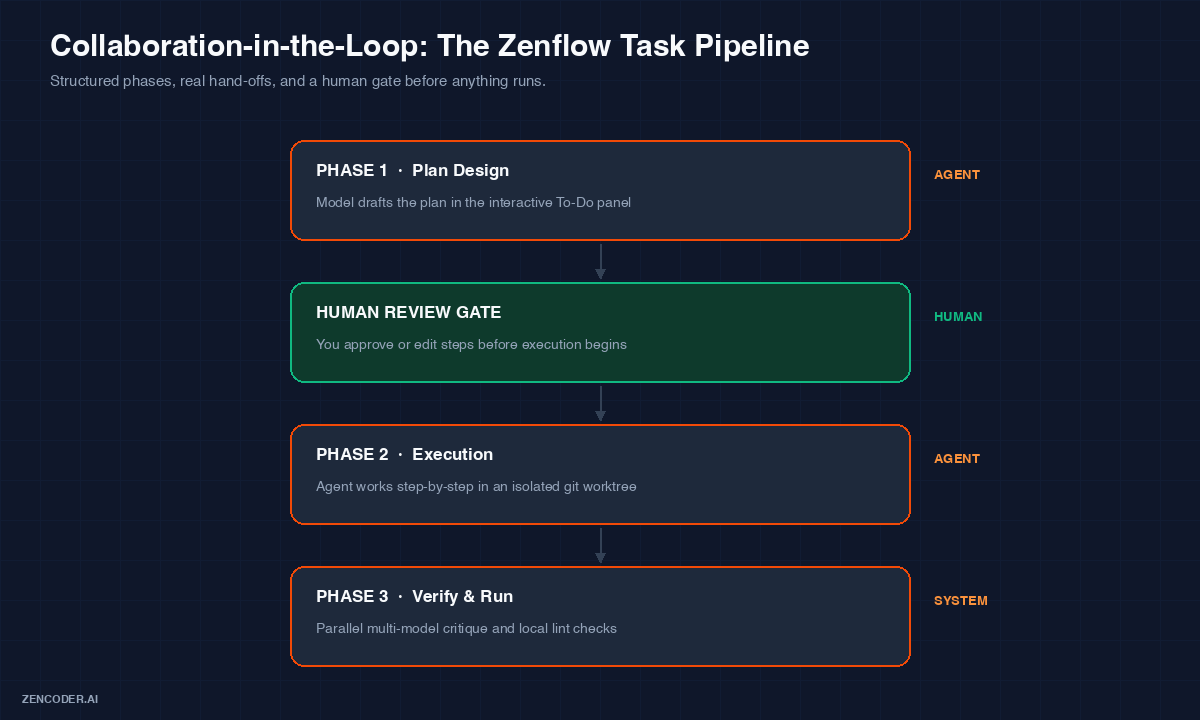
The Zenflow task pipeline separates agent work from human decision points. The plan is drafted, then approved, then executed inside an isolated worktree, and finally cross-checked by a second model.
The plan lives in an actual To-Do panel, not buried in a chat scrollback. If a step needs a human eye, say, confirming a Salesforce layout or verifying a ServiceNow Script Include, the agent stops, links the chat to the step, and waits. It feels less like watching a black box and more like pairing with someone who is not afraid to ask.
The payoff nobody talks about
Most of the numbers people quote about AI productivity are, frankly, made up. But there are some patterns we see repeatedly once teams move from unsupervised agents to a collaborative setup:
- Fewer defects, because a second model catches the obvious stuff before a human wastes time on it.
- Fewer surprise deployments, because the human gate quietly filters out the weird architectural detours.
- More adoption, which is the one that actually matters. Engineers use tools they trust, and they trust tools that let them stay in control.
Autonomy is a great slogan. Collaboration is a better product. If you build for the second one, the first one shows up on its own, in the places where it actually deserves to.