As the use of AI continues to grow, it’s becoming clear that not all AI systems are designed to function the same way. While agentic AI and generative AI are often grouped together, they serve very different purposes. From the way they operate to their decision-making processes, these two approaches reflect fundamentally different AI capabilities. In this article, we’ll break down the key differences between agentic AI vs. generative AI to help you understand when each type of AI is best used.

Key Takeaways
- Generative AI creates content, while agentic AI takes action. Generative AI produces text, code, images, and other outputs from prompts, whereas agentic AI can plan, execute, and adapt actions to achieve defined goals.
- The biggest difference is autonomy. Generative AI requires continuous human prompting, while agentic AI can operate independently within predefined objectives and constraints.
- Generative AI focuses on output generation. Common use cases include content creation, code generation, summarization, research assistance, and creative workflows.
- Agentic AI focuses on execution and decision-making. It can coordinate workflows, call APIs, update systems, automate processes, and respond to changing conditions with minimal human intervention.
- Agentic AI introduces greater operational benefits and greater risk. Its ability to act autonomously can improve efficiency and scalability but requires stronger governance, security controls, and oversight.
- Generative AI is best suited for assisting people, while agentic AI is designed to complete tasks and achieve outcomes.
- Many modern platforms combine both approaches. Generative models provide intelligence and content creation, while agentic systems use that intelligence to plan, execute, verify, and optimize workflows.
- In software development, the industry is moving toward agentic workflows. Platforms such as Zencoder combine AI-assisted code generation with autonomous testing, review, verification, and workflow orchestration to reduce manual effort across the software delivery lifecycle.
Agentic AI vs Generative AI: Key Differences Overview
Before describing the differences between agentic AI and generative AI, here is a quick overview of what awaits you:
|
Category |
Agentic AI |
Generative AI |
|
Primary Function |
Acts autonomously to achieve a defined goal through planning and execution |
Generates content such as text, images, code, or media based on prompts |
|
Autonomy Level |
High autonomy with minimal ongoing human supervision |
Low autonomy and fully dependent on human prompts |
|
Goal Orientation |
Proactively pursues objectives and adapts actions over time |
Reactively responds to individual requests |
|
Decision Making |
Uses multi-step reasoning memory and feedback loops to decide actions |
Uses pattern recognition without true reasoning or planning |
|
Execution Capability |
Executes real actions such as triggering workflows, updating systems, and calling APIs |
Produces outputs only and does not execute actions on its own |
|
Human Involvement |
Limited involvement mainly for oversight exceptions or ethical review |
Continuous involvement required for prompting and validation |
|
Risk Profile |
Higher operational risk due to autonomous real-world actions |
Lower operational risk focused on content accuracy and bias |
What Is Agentic AI?
Agentic AI is a type of artificial intelligence that can work toward a specific goal with minimal human supervision, using AI agents that make decisions and solve problems in real time. In multi-agent systems, different agents handle specialized subtasks and are coordinated in a way that enables the system to plan, adapt, and act effectively rather than following fixed rules.
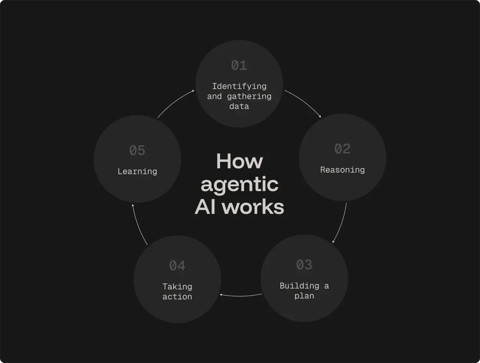
While generative AI models focus on producing outputs based on learned patterns, agentic AI uses those outputs to take action and advance toward a specific goal.
Best Use Cases of Agentic AI
Here are some of the best use cases of agentic AI:
- Customer service – Agentic AI is redefining customer support by quickly and independently resolving routine issues. Instead of following rigid scripts like traditional chatbots, it understands context and takes action. For example, an AI Agent Builder can track delayed shipments and identify the cause.
- Application development and IT operations – In software development, agentic AI is becoming as essential as traditional tools. It helps developers write and improve code, automates testing, and analyzes results in real time. By reducing errors and speeding up workflows, teams can focus more on complex, high-impact work.
- Application security and cybersecurity – As cyber threats continue to grow, agentic AI provides a smarter, more proactive layer of defense. It continuously monitors applications, networks, and user behavior to spot unusual activity and assess risk. When issues are found, it can prioritize vulnerabilities and apply fixes faster, minimizing exposure to attacks.
- Healthcare – Agentic AI serves as a proactive partner in healthcare, supporting patients, clinicians, and administrative teams. It enables continuous patient monitoring, assists clinicians with faster, more accurate diagnoses, and automates tasks such as scheduling, billing, and record management, areas where integrated medical billing software further reduces manual overhead for UK clinics.
Pros and Cons of Agentic AI
Agentic AI offers many advantages but also poses important challenges that need careful consideration. Here are its most important pros and cons:
🟢 Pros:
- Faster operations – Agentic AI takes over complex and time-consuming tasks, significantly accelerating workflows and reducing delays. By removing operational bottlenecks, organizations can run more smoothly and allow human teams to focus on creative, strategic, and high-impact work.
- Data-driven decisions – With the ability to process massive datasets and apply predictive analytics, agentic AI can make decisions faster, and often more accurately, than humans. This is especially valuable in high-pressure environments like agentic AI in insurance, finance, healthcare, and emergency response, where speed and precision matter most.
- Fewer errors and greater reliability – Human error caused by fatigue, distraction, or repetitive work is a common risk. Agentic AI reduces these mistakes, delivering consistent performance in precision-critical areas such as manufacturing, logistics, data processing, and safety systems.
- Always on, 24/7 – Agentic AI doesn’t need breaks. Its continuous operation enables round-the-clock customer support, real-time monitoring, and uninterrupted services.
- Long-term cost savings – While the initial investment can be high, agentic AI often lowers costs over time. It reduces labor expenses, minimizes costly errors, optimizes resource usage, and allows organizations to scale efficiently without expanding headcount at the same rate.
🔴 Cons:
- Limited emotional understanding – Agentic AI excels at logic and data, but not empathy. It cannot understand emotions or moral nuance, making human involvement essential in areas like healthcare, education, leadership, and customer service.
- Ethical and bias concerns – AI systems learn from data, and if that data contains bias, the AI can unintentionally reinforce or amplify it. This raises serious concerns around fairness, accountability, and discrimination in fields such as hiring, lending, policing, and healthcare.
- High upfront costs – Implementing agentic AI requires significant investment in infrastructure, software, integration, and skilled professionals. For small and mid-sized organizations, these costs can be a major barrier to adoption.
- Over-dependence on technology – Relying too heavily on agentic AI can weaken human expertise and judgment. It also increases risk if systems fail, are compromised by cyberattacks, or encounter situations they were not designed to handle.
- Security and privacy risks – Because agentic AI processes large amounts of sensitive data and operates with autonomy, it expands the attack surface for data breaches and misuse. Without strong security controls and oversight, organizations may face serious privacy and regulatory challenges.
What Is Generative AI?
Generative AI is artificial intelligence (AI) that can generate new text, images, video, audio, or software code based on a user’s prompt. It uses advanced deep-learning models that analyze massive amounts of data to recognize patterns, understand natural language, and generate relevant new responses.
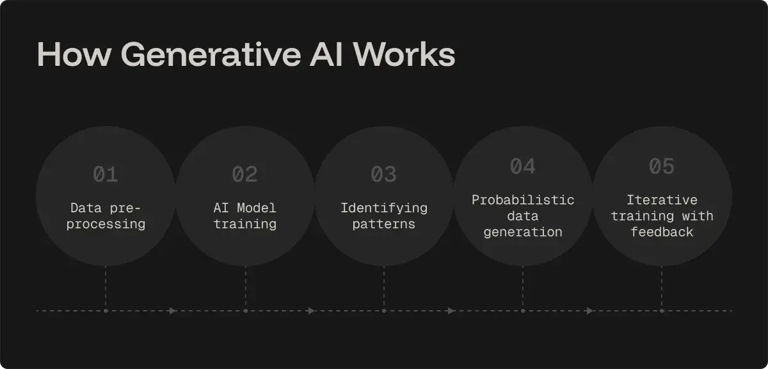
This capability enables people and organizations to automate tasks, explore ideas faster, and enhance creative and analytical work.
Best Use Cases of Generative AI
Here are some of the best use cases of generative AI:
- Code generation – Generative AI supports software development by producing code across multiple languages and frameworks. It helps developers by suggesting improvements, completing code, generating boilerplate, and creating unit tests, allowing teams to work faster while focusing on higher-value problems.
- Repetitive task automation – AI systems can streamline repetitive administrative work such as data entry, document processing, and formatting. By automatically extracting and organizing information through a robust AI-Powered workplace search, GenAI reduces manual labor and improves accuracy across complex, data-heavy workflows.
- Content marketing – GenAI helps businesses better understand their audiences by analyzing large volumes of customer and market data. These insights enable personalized messaging, targeted recommendations, and more effective marketing campaigns, including UGC-style Ads tailored to individual user needs.
- Content creation – GenAI enables teams to quickly produce written, visual, and video content from simple prompts. Tools such as an AI blog writer help automate blog posts, newsletters, and social media content, making large-scale content distribution faster and more consistent. This accelerates the creation of blogs, social media posts, product descriptions, and creative assets while maintaining consistency and scale. Tools like the AI video generator also help transform written prompts into engaging video content, allowing teams to expand their content strategy beyond text and visuals. For teams looking to maintain structure across written content, a blog post template provides a repeatable format that ensures consistency in tone and style across posts.
Pros and Cons of Generative AI
Generative AI brings powerful creative and productivity benefits, but it also presents notable risks and limitations. Below are the most important advantages and disadvantages to consider:
🟢 Pros:
- Rapid content creation at scale – Generative AI can produce large volumes of text, images, code, audio, and video in seconds. This significantly reduces production time for marketing teams, developers, educators, and content creators, enabling faster go-to-market strategies. It can also enable conversational video editing, allowing users to make video edits using natural language prompts instead of traditional editing tools, making content production faster and more accessible.
- Boosts creativity and ideation – By generating multiple variations and ideas from a single prompt, generative AI helps users explore creative directions they may not have considered. It acts as a brainstorming partner, accelerating innovation across design, storytelling, and product development.
- Improves productivity and efficiency – Automating tasks such as drafting documents, summarizing information, writing code, and creating presentations allows professionals to focus on higher-value strategic and analytical work.
- Accessible to non-technical users – With natural language interfaces, generative AI tools require little to no technical expertise. This democratizes advanced capabilities, allowing individuals and small teams to perform tasks that once required specialized skills.
- Personalization at scale – Generative AI enables personalized content, recommendations, and communications tailored to individual users. This is especially valuable in marketing, education, and customer engagement, where relevance improves outcomes.
🔴 Cons:
- Risk of inaccurate or misleading outputs – Generative AI can produce content that sounds confident but is factually incorrect or outdated. Without human review, these “hallucinations” can lead to misinformation, poor decisions, and reputational damage.
- Lack of true understanding or reasoning – While generative AI mimics human language and creativity, it does not truly understand context, intent, or meaning. This limits its reliability in complex decision-making or nuanced scenarios.
- Intellectual property and copyright concerns – Since generative AI models are trained on large datasets, questions arise around content ownership, plagiarism, and copyright infringement, especially in creative and commercial use cases.
- Bias and ethical challenges – If training data contains bias, generative AI can reproduce or amplify stereotypes and unfair representations. This raises ethical concerns in areas like hiring, media, education, and public discourse.
- Overreliance and skill degradation – Excessive dependence on generative AI may reduce critical thinking, writing, and problem-solving skills over time. Organizations must balance automation with human oversight to avoid long-term capability loss.
Agentic AI vs. Generative AI: Key Differences
Below is a detailed comparison of agentic AI vs generative AI across key dimensions that matter most to businesses and technical teams.
1. Goal Orientation and Autonomy
Generative AI operates in a reactive mode. It responds to prompts by generating text, images, code, or other outputs, but it does not independently pursue goals or decide what to do next. Every action requires a human prompt, and once the output is delivered, the task is complete.
Agentic AI, in contrast, is goal-driven and proactive. It can break a high-level objective into subtasks, decide which actions to take, execute them, evaluate outcomes, and adjust its approach over time. These systems can operate continuously with minimal human input.
2. Decision-Making and Reasoning Capabilities
Generative AI relies on pattern recognition and probabilistic prediction. It generates responses based on what is most likely to follow in context, but it does not truly reason, plan, or evaluate consequences beyond the immediate output.
Agentic AI incorporates decision-making frameworks, planning logic, memory, and feedback loops. It can reason across multiple steps, compare options, prioritize actions, and revise decisions based on new data or changing conditions.
3. Human Involvement and Oversight
Generative AI requires constant human involvement. Users must initiate each interaction, refine prompts, validate outputs, and decide how to use the generated content. Without human direction, generative AI remains idle.
Agentic AI significantly reduces hands-on involvement. Once objectives, constraints, and permissions are defined, the system can operate independently, escalating to humans only when exceptions, ethical concerns, or confidence thresholds are reached.
4. Adaptability and Learning over Time
Generative AI models are typically static at runtime. While they may improve through retraining or fine-tuning, they usually do not learn from individual interactions in real time or adjust behavior dynamically during ongoing tasks.
Agentic AI systems are built to learn continuously. They can store memory, learn from outcomes, incorporate feedback, and refine strategies as conditions change. This makes them especially effective in dynamic environments.
5. Execution vs. Output Generation
Generative AI’s core strength is content creation. It generates images, text, code, or summaries but stops short of executing tasks in real-world systems unless paired with external automation tools.
Agentic AI goes beyond generation. It can trigger workflows, call APIs, update databases, deploy fixes, communicate with other systems, and verify whether actions succeeded.
6. Risk Profile and Control
Generative AI poses risks mainly due to hallucinations, bias, and misinformation. These risks are mitigated through human review, content filtering, and usage guidelines. Content filtering plays a critical role in preventing harmful, biased, or inaccurate outputs from reaching end users.
Agentic AI introduces higher operational risk because it can act autonomously. Errors, security vulnerabilities, or misaligned objectives can have direct real-world consequences, making governance, guardrails, and monitoring essential.
From AI That Generates to AI That Gets Work Done
As AI continues to evolve, the real advantage lies in moving beyond tools that simply generate outputs to systems that actively drive outcomes. The next generation of developer platforms blends generative intelligence with agentic capabilities to help teams plan, act, and deliver faster with less manual effort.
This is exactly what Zencoder does for software developers!
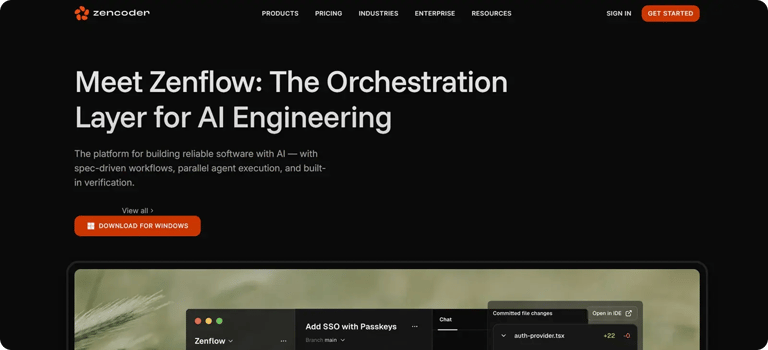
Zencoder is an AI-powered coding agent platform that embeds intelligent agents directly into developers’ workflows to automate and accelerate software development tasks. Its proprietary Repo Grokking™ technology deeply understands entire codebases and cross-repo dependencies. This enables Zencoder to produce high-quality, project-specific code and maintain consistent conventions across your stack.
Zencoder Key Features:
1️⃣ Zenflow – An AI-first engineering platform that coordinates multiple AI agents to build, test, and ship reliable software with clean, structured workflows and consistent results.
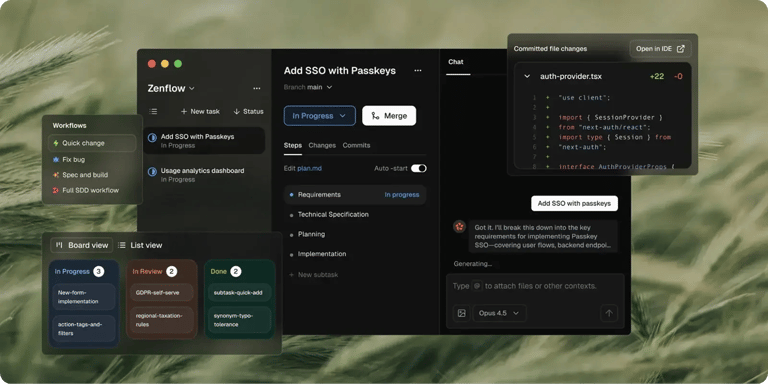
Here’s what Zenflow lets you do:
- Build from specs, not guesses – Agents read your specs, PRDs, and architecture docs before writing code, so implementations stay aligned with requirements and avoid drift.
- Use proven or custom workflows – Prebuilt workflows handle features, bugs, and refactors, with the flexibility to design and run fully custom processes tailored to your team.
- Verify before shipping – Every workflow includes automated testing and cross-agent code review. If tests fail, agents automatically fix the issues.
- Run work in parallel – You can execute multiple tasks simultaneously in isolated environments, allowing features, fixes, and refactors to move faster without code conflicts.
- Coordinate multiple agents seamlessly – Specialized agents for coding, testing, refactoring, review, and verification work together as one system with shared context.
2️⃣ AI Coding Assistant – Zencoder helps streamline your development workflow with an all-in-one AI solution that includes:
- Code Completion – Smart, context-aware suggestions that maintain development momentum, reduce errors, and improve overall productivity.
- Code Generation – Intelligent automation that delivers clean, consistent, production-ready code aligned with project objectives and established coding standards.
- Code Review Agent – Continuous, automated code review that enforces best practices, identifies potential issues early, and strengthens security through precise, actionable feedback.
- Chat Assistant – Real-time, context-sensitive support that provides accurate answers, expert guidance, and personalized recommendations to optimize developer workflows.
3️⃣ Zentester – Automate testing at every level, so you can catch bugs early and ship high-quality code faster. Describe what you want to test in plain English, and Zentester will take care of the rest, adapting as your code evolves.
Here’s what it does:
- Our AI agents understand your application architecture and operate seamlessly across UI, API, and database layers.
- As your code evolves, Zentester automatically updates test suites, removing the need for constant manual rewrites.
- From individual unit functions to full end-to-end user flows, every layer of your app is thoroughly tested.
- Zentester’s AI identifies high-risk code paths, uncovers hidden edge cases, and generates tests based on real user behavior patterns.
4️⃣ Security treble – Ensures enterprise-grade protection with SOC 2 Type II, ISO 27001, and ISO 42001 certifications, making Zencoder the only AI coding agent with all three.
5️⃣ Multi-Repo Search – Easily index and search across multiple repositories, making it simple for AI agents to understand and navigate even the most complex, multi-repo architectures. You can manage everything from one intuitive web admin panel, giving agents seamless access to explore, query, and work with your entire indexed codebase whenever they need it.
Start using Zencoder’s AI agents to reduce manual effort and move code from idea to production faster.