Spec-driven development (SDD) and vibe coding are widely discussed approaches in modern software development because of their impact on speed, quality, and developer workflow. Each method offers a different framework for structuring the coding process, from strict planning and documentation to more intuitive, exploratory practices. These differences can affect how software is designed, built, and maintained.
In this article, we’ll compare spec-driven development vs. vibe coding to clarify how each approach works, where they differ, and when one may be more suitable than the other.

What Is Spec-Driven Development?
Spec-driven development is an AI-driven approach in which you write the specification first, and the code comes second. Instead of jumping straight into implementation, teams clearly define what the software should do before writing any code.

That specification, often written in clear, structured natural language, serves as the primary reference that both developers and AI use to generate and validate code.
How Spec-Driven Development Works
Spec-driven development has a clear, step-by-step structure that guides development from idea to implementation.
Step 1: Write the Spec (“What” and “Why”)
The developer (or product owner) starts by describing the feature in natural language. This includes project goals, user stories, and success criteria, without going into implementation details. For example, using a GitHub Spec Kit workflow, you might run a /specify command that asks, “What are we building and why?” From this input, the AI generates a high-level requirements document (PRD) that captures business logic and user needs while intentionally leaving out technical decisions.
Step 2: Create a Technical Plan (“How”)
Next, the team outlines the technical approach. This may involve specifying the technology stack, frameworks, data models, and other constraints. The AI can generate a detailed implementation outline, including design diagrams, library selections, and API specifications, aligned with the project’s guidelines.
Step 3: Divide Work into Tasks
Once the spec and technical plan are complete, the AI turns them into a clear list of small, actionable tasks. For instance, instead of a vague instruction like “build user authentication,” the AI might output a task such as “Create a user registration endpoint that validates email format,” complete with stub code or test cases. This approach mirrors test-driven development, where every task has a specific goal and can be verified in isolation.
Step 4: Let AI Generate Code
Finally, the AI coding agent tackles the tasks one by one. For each task, it writes code to satisfy the specification. Because the tasks are small and well-defined, the AI has clear guidance and minimal ambiguity. This typically results in a sequence of focused commits or pull requests, each implementing a specific part of the overall feature.
What Is Vibe Coding?
Vibe coding is a more freeform, conversational approach to AI-assisted programming. Instead of starting with detailed requirements or writing code line by line, you begin by describing what you want in plain language. The AI then generates code based on your explanation. From there, you refine the results through conversation—by giving feedback, clarifying your goals, and adjusting direction as needed.

In practice, you share your intent, the AI produces the code, and you respond with tweaks or new ideas. Instead of drafting formal specifications or worrying about syntax, you guide the AI toward that outcome step by step.
How Vibe Coding Works
Vibe coding operates as an iterative conversational loop between the developer and the AI. There’s no fixed plan document; instead, the process often includes the following steps:
Step 1: Write a High-Level Prompt
The developer starts by describing the goal in plain language. For example: “Create a Python script that reads a CSV of customer data and outputs summary statistics.” This initial prompt sets the direction but does not include code or detailed steps.
Step 2: Let AI Generate Code
The AI assistant reads the prompt, interprets the objective, and generates code designed to accomplish the task. Depending on the request, it may produce a complete function, several related functions, or a structured outline that can be expanded further.
Step 3: Execute and Observe
The developer runs or reviews the generated code to evaluate whether it meets the intended requirements. In many cases, the AI’s first attempt will be close to what you need but not perfect, requiring further refinement or clarification.
Step 4: Refine with Follow-Up Prompts
The developer then provides feedback or additional instructions in natural language. For example, “This works, but add error handling for missing files” or “Instead of using pandas, write it using only standard Python libraries.” The AI receives this new prompt and produces updated code.
Step 5: Repeat
Steps 2 and 4 are repeated as needed. With each iteration, the developer keeps specifying fixes or new features, and the AI keeps adjusting the code. The loop continues until the application behaves as desired.
Spec-Driven Development vs. Vibe Coding: Key Differences
Both SDD and vibe coding use AI to help write code, but they approach planning very differently. Below is a comparison of the two approaches across several key areas.
1. Planning and Approach
Spec-driven development is structured and phase-based. Work moves deliberately from defining outcomes to breaking work into precise tasks, and only then to generating code. The emphasis isn’t just on writing a spec; it’s on using that spec as the backbone of the entire workflow. Each stage builds on the previous one, reducing ambiguity and guiding the AI with clear constraints.
Vibe coding, by contrast, relies on improvisation. Instead of detailed upfront planning, you jump into coding almost immediately, using only high-level ideas as guidance. The process typically feels like an ongoing conversation or sketch session, where ideas evolve as you go and the AI fills in the gaps.
2. Human Role and Expertise
In SDD, the human is the author of the specification. A developer or product lead must articulate the feature requirements and constraints. This often requires domain knowledge and planning skills. Once the specification is complete, the AI’s role is to translate that written spec into code. However, humans still review and guide the process at every stage.
In vibe coding, the human’s role shifts from planner to prompter and tester. You need a clear sense of what you want at a high level, but you don’t need to know how to implement it in code. This makes vibe coding accessible even to non-experts. The key skill is no longer traditional programming, but creating effective prompts, evaluating the AI’s output, and iterating based on the results.
3. Collaboration and Communication
SDD produces clear, shareable documentation that outlines the project’s goals, requirements, and key decisions in plain language. This shared specification keeps team members aligned and reduces misunderstandings. When new developers join, they can quickly get up to speed just by reading the spec.
Vibe coding typically happens between one developer and an AI assistant, so knowledge lives in chat transcripts and generated code. There is usually no formal, high-level document that explains the overall intent or reasoning behind decisions. As a result, new contributors may need to comb through conversation history or reverse-engineer the code to understand the project.
4. Speed and Prototyping
SDD moves more slowly at the start because teams invest time in planning and writing the specification before coding begins. This upfront effort can feel tedious, but it helps surface assumptions and catch problems early, when changes are cheap. Once the spec is solid, development tends to move more smoothly and predictably.
Vibe coding emphasizes speed and immediate results by skipping formal planning and jumping straight into code. It’s well-suited for rapid prototyping, quick experiments, and short projects where ideas can be tested in hours rather than days. That early speed can be misleading, though, since rough prototypes often require significant cleanup or rework later.
5. Code Quality and Maintainability
SDD generally leads to more intentional and maintainable code because the AI is guided by clear, explicit requirements. This reduces the chance of incorrect assumptions and encourages better structure, testing, and architectural decisions. As many analysts note, this upfront investment often results in higher long-term quality and lower technical debt.
Vibe coding can lead to uneven or fragile code, especially when AI-generated output is accepted without deep review. While the AI can quickly generate working solutions, it may overlook best practices, introduce subtle bugs, or create architectural inconsistencies. Because the reasoning behind decisions is rarely documented, misunderstandings or errors can quietly spread across the codebase. Over time, these issues can accumulate into significant technical debt, which is why strong testing and human oversight are essential.
6. Use Cases and Target Users
SDD is a strong fit for larger teams and complex, long-lived projects where clarity and accountability matter. It works especially well for organizations building enterprise software, regulated systems, or products expected to evolve over many years. SDD also aligns naturally with existing formal practices like test-driven development (TDD) and agile user stories, making it easy to adopt in mature engineering environments. It tends to appeal to developers and teams that value control, traceability, and confidence in how every feature is implemented.
Vibe coding excels in fast-moving, low-overhead scenarios where speed and accessibility are the primary goals. It’s ideal for rapid prototyping, solo projects, hackathons, and situations where technical expertise is limited. Non-programmers, such as designers, product managers, or founders, can use vibe coding to experiment with ideas and build working prototypes. However, because it relies heavily on trusting AI output, it’s generally a poor fit for mission-critical systems or environments with strict security and compliance requirements.
Bridging Spec-Driven Development and Vibe Coding with Zencoder
Both spec-driven development and vibe coding highlight an important truth: AI can dramatically accelerate software development, but only when it is guided correctly. Vibe coding favors speed and accessibility, while SDD emphasizes clarity, control, and long-term quality. In practice, most teams need both fast iteration early on and strong guardrails as projects mature.
This is where Zencoder comes in.
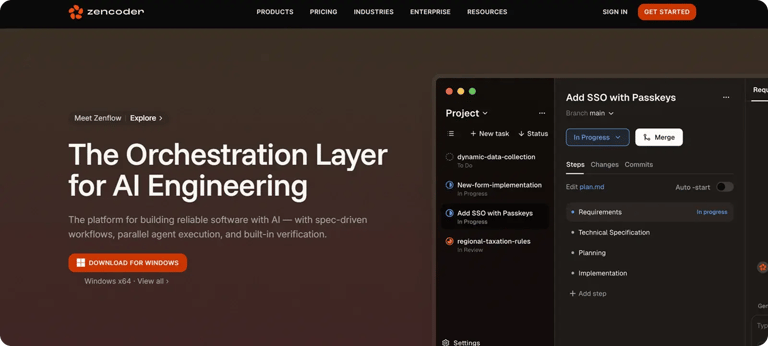
Zencoder is an AI-powered coding agent that automates and accelerates software development workflows by generating, testing, and refining production-ready code. It integrates seamlessly with your existing development tools, supports 70+ programming languages, and works with popular IDEs like Visual Studio Code and JetBrains.
Here is how Zencoder supports both SDD and vibe coding:
- Spec-driven development – Zenflow turns specs into executable workflows, coordinating multiple AI agents with built-in testing, review, and verification to keep implementations tightly aligned with requirements.
- Vibe coding – Intelligent agents support rapid, conversational iteration, generating, refining, debugging, and testing code while minimizing cleanup, rework, and long-term drift.
Key Features
1️⃣ Zenflow – Zenflow is an AI-first engineering platform designed to coordinate multiple specialized AI agents to build, test, and deliver reliable software with confidence.
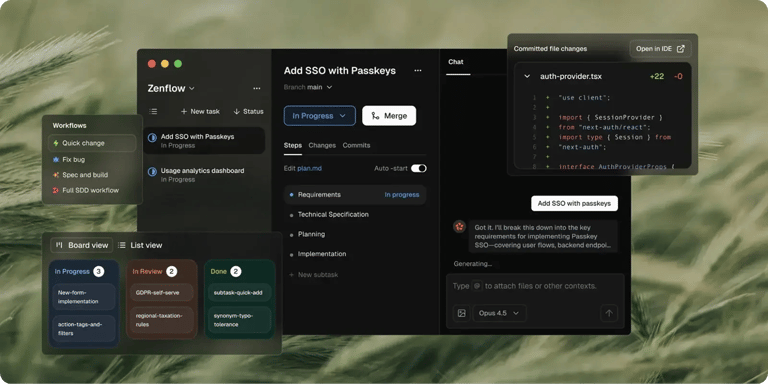
With Zenflow, teams can:
- Seamlessly coordinate multiple agents – Dedicated agents for coding, testing, refactoring, review, and verification operate together as a unified system.
- Verify before shipping – Every workflow includes automated testing and cross-agent code review. When tests fail, agents automatically diagnose and resolve issues before delivery.
- Build from specifications – Agents ingest product requirements, specifications, and architecture documents before implementation, ensuring strict alignment with the defined requirements.
- Leverage proven or custom workflows – Zenflow provides battle-tested workflows for feature development, bug fixes, and refactoring, with full support for custom, team-specific processes.
- Run work in parallel – Multiple tasks can be executed simultaneously in isolated environments, accelerating delivery while avoiding conflicts across features, fixes, and refactors.
2️⃣ AI Coding Assistant – Optimize your development workflow with a fully integrated AI solution that improves efficiency and accelerates end-to-end software delivery.
- Code Generation – Produce clean, production-ready code that is consistent, maintainable, and aligned with your project requirements and established engineering standards.
- Code Completion – Receive context-aware suggestions that minimize errors, improve overall productivity, and maintain development momentum.
- Chat Assistant – Access real-time, dependable guidance with personalized coding support and intelligent recommendations designed to keep your workflow efficient and focused.
- Code Review Agent – Get automated code review to ensure adherence to best practices, identify potential issues early, and enhance security through actionable feedback.
3️⃣ Zentester – Zentester uses AI to automate testing at every level, so you can catch bugs early and ship high-quality code faster. Just describe what you want to test in plain English, and Zentester takes care of the rest, adapting as your code evolves.
Here is what it does:
- Intelligent agents understand your app and interact naturally across the UI, API, and database layers.
- Zentester automatically updates your tests as your code changes, eliminating the need for constant rewriting.
- Every layer of your app is thoroughly tested at scale.
- AI identifies risky code paths, uncovers hidden edge cases, and generates tests based on how real users interact with your app.
4️⃣ Zen Agents – Zen Agents are customizable AI teammates that understand your codebase, integrate seamlessly with your existing tools, and can be deployed in seconds. Here is what you can do:
- Connect to tools like Jira, GitHub, and Stripe in minutes with our no-code MCP interface, so agents can operate seamlessly within your existing workflows.
- Create specialized agents for pull request reviews, testing, and refactoring, each tailored to your architecture, frameworks, and development standards.
- Deploy agents organization-wide with one click, including automatic updates and shared access to ensure teams stay aligned and expertise scales effortlessly.
5️⃣ Multi-Repo Search – Seamlessly index and search across multiple repositories, allowing AI agents to understand and operate within complex, multi-repo architectures. Manage repositories from a centralized web admin panel and explore your fully indexed codebase whenever needed.
6️⃣ Security treble – Zencoder meets the highest enterprise security standards with SOC 2 Type II, ISO 27001, and ISO 42001 certifications, making it the only AI coding agent certified across all three frameworks.
Try Zencoder today and turn fast ideas and clear specifications into reliable, production-ready code.