Agentic AI refers to a new generation of artificial intelligence systems that can act autonomously, make decisions, and execute tasks with minimal human intervention, moving beyond simple prompt-based tools.
As these systems evolve, they are increasingly being used across software development, operations, and security to automate complex workflows, collaborate across tasks, and optimize outcomes in real time. In this article, we will explore seven agentic AI examples that show how these intelligent systems are transforming modern workflows.

Key Takeaways
- Agentic AI moves from tools to autonomous teammates
Instead of just assisting, AI agents now independently plan, decide, and execute tasks with minimal human input. In many cases, multiple agents collaborate in real time to achieve a shared goal, making them feel more like digital coworkers than simple tools.
- Software development is becoming largely self-operating
From generating code to fixing bugs and updating dependencies, agentic AI is automating major parts of the development lifecycle. Teams are seeing faster delivery and less manual work as AI integrates directly into workflows like CI/CD and version control.
- Operations and testing are now adaptive, not reactive
AI agents continuously monitor pipelines, detect issues early, and even fix them automatically. Testing evolves with your code, prioritizes risk, and generates new test cases on the fly, improving reliability without extra effort.
- Security and observability must evolve alongside AI autonomy
As AI agents take more control, risks increase. That is why modern systems embed security scanning, policy enforcement, and real-time monitoring directly into agent workflows. Dedicated agents now serve as safeguards, catching vulnerabilities and preventing unsafe actions.
- The real value comes from multi-agent collaboration, not single tools
The biggest leap happens when specialized agents work together across coding, testing, reviewing, and deployment. Platforms like Zencoder make this practical by orchestrating multiple agents that understand your codebase and execute tasks end-to-end, helping teams move faster while maintaining quality and control.
What Is Agentic AI?
Agentic AI refers to artificial intelligence systems that can achieve a specific goal with minimal human guidance. These systems are made up of AI agents – machine learning models designed to make decisions and solve problems in ways that resemble human thinking, often in real time.
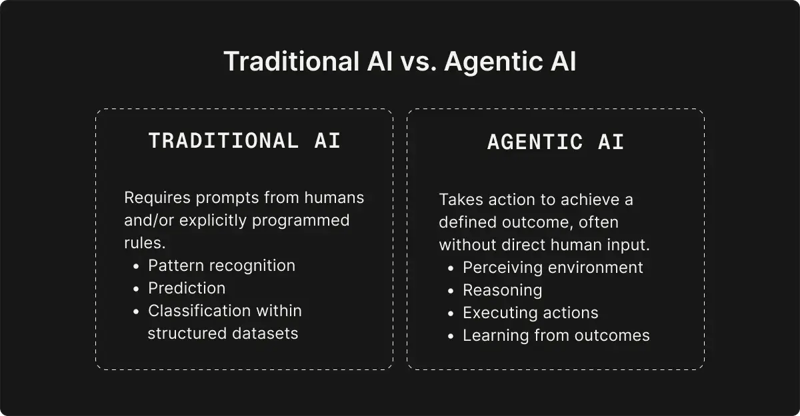
In more complex setups, multiple agents work together as part of a multi-agent system. Each agent handles a specific piece of the task, and their actions are coordinated through AI orchestration to ensure everything works smoothly toward the final objective.
7 Agentic AI Examples
The following examples show how agentic AI is being used in 2026 to simplify and improve software development, operations, and security.
1. Code Generation and Refactoring
AI code assistants have evolved far beyond simple autocomplete, now capable of tasks such as:
- Generating boilerplate code to speed up development
- Refactoring legacy codebases to improve maintainability
- Updating dependencies to keep projects current
- Producing documentation or tests directly from natural-language prompts
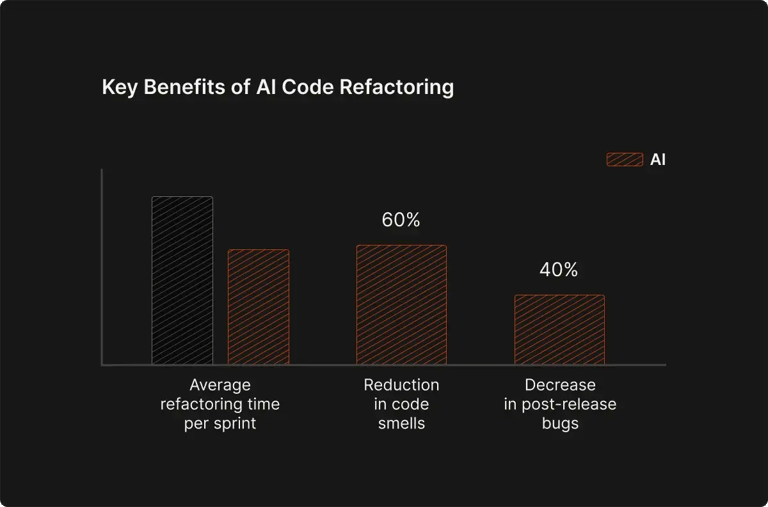
By 2025, over 90% of developers had used these tools, with some projects seeing 30–50% of their code generated by AI, while advanced agents integrate directly with CI/CD pipelines to detect configuration drift and automatically create and commit fixes. For example, Zencoder’s autonomous CI agents are event-driven, meaning they can be triggered by changes in tools like GitHub or Jira to automatically fix bugs, refactor code, and push production-ready updates, turning the CI pipeline itself into an active, self-operating contributor.
Tracking AI usage statistics across teams also helps organizations see how widely these tools are adopted and where they deliver the most value.
2. Continuous Integration/Continuous Delivery (CI/CD) Monitoring and Orchestration
Modern CI/CD pipelines involve dozens of jobs, from building and testing to security scanning and deployment, making them complex and time-consuming to manage. Agentic AI is transforming this process by automating orchestration and monitoring, which includes:
- Tracking pipeline stages in real time to detect failures early
- Automatically re-running flaky tests or failed jobs
- Identifying root causes using logs and contextual data
- Generating fixes, pull requests, and commit messages to resolve issues
This means CI/CD systems no longer just report failures; they actively diagnose problems, propose and implement solutions, and re-trigger pipelines without human intervention.
3. Bug Triage and Prioritization
Triaging incoming bug reports and deciding what to fix first can quickly consume valuable engineering time. Instead of relying on manual sorting, AI agents can streamline this process by analyzing reports, identifying what matters most, and routing issues to the right people, so teams can focus on fixing problems rather than organizing them.
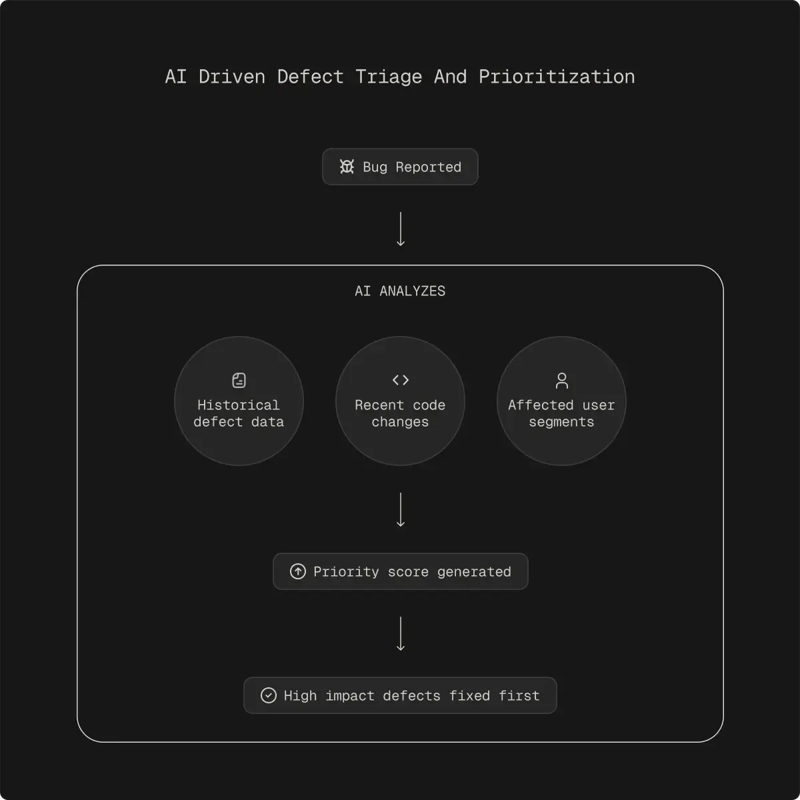
For example, triage agents can:
- Analyze and enrich bug reports – Extract key details such as stack traces, error patterns, and affected components to add useful context
- Detect duplicates automatically – Compare new reports against existing issues to reduce noise and prevent redundant work
- Assign severity and priority – Evaluate impact based on factors like frequency, affected users, and system criticality
- Route issues to the right teams – Ensure each bug reaches the appropriate owner with all relevant context included
- Escalate critical issues – Surface high-impact problems quickly and notify teams through tools like Slack or PagerDuty
- Validate before escalation – Filter out false positives so engineers are only interrupted for real, actionable issues
4. Adaptive Testing Workflows
Testing has evolved from simple unit tests to complex suites that include UI, API, integration, and performance testing. As applications grow, maintaining these test suites becomes increasingly difficult, especially since frequent code changes require constant updates.
Agentic AI transforms testing by making it adaptive and goal-driven rather than static, with capabilities such as:
- Automatically generating test cases from user stories and requirements
- Adapting tests to changes in UI layouts or API contracts
- Managing and generating synthetic test data
- Prioritizing test execution based on recent code changes and risk levels
For example, Zencoder’s Zentester uses AI to automate testing across every layer of your application, helping teams catch bugs sooner and release high-quality software faster. You can describe what you want to test in plain English, and Zentester adapts automatically as your codebase changes.
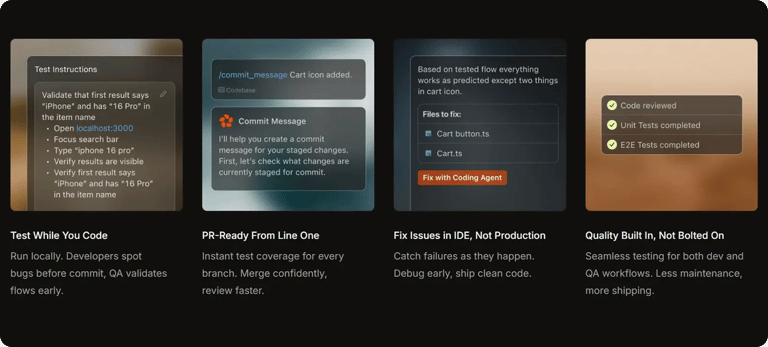
Here’s what it does:
- Automatically updates tests as your code evolves, eliminating manual rewrites
- Tests every layer of your application at scale, from unit functions to full end-to-end user journeys
- Uses intelligent agents that understand your application architecture and interact with the UI, APIs, and database
- Identifies risky code paths, uncovers hidden edge cases, and generates tests based on real user behavior
👉 Watch Zentester in action:
5. Security Scanning and Risk Management
As agentic AI takes on a larger role in the development lifecycle, security becomes both more important and more complex. While it can accelerate development, it also increases the risk of introducing vulnerabilities.
Because these systems can operate independently, issues such as insecure code patterns, unverified dependencies, or even hallucinated components may go unnoticed. To manage these risks, security is increasingly embedded directly into the agentic workflow.
Key elements of this approach include:
- Continuous security scanning – Automated checks run across the entire development lifecycle, not just at the end.
- Static application security testing (SAST) – Code is analyzed as it is generated to detect vulnerabilities early.
- Dependency scanning – New libraries and packages are verified to prevent the introduction of known risks.
- Policy enforcement – Rules are applied automatically to block unsafe code or non-compliant changes.
- Automated escalation – High-risk issues are flagged and routed to the appropriate teams without delay.
In more advanced setups, dedicated security agents act as real-time safeguards. They monitor changes made by other agents, detect insecure patterns, and intervene when necessary. Because agents often depend on third-party models and tools, vendor risk management also becomes part of keeping these workflows secure.
6. DevOps Observability and Incident Response
Modern applications generate massive volumes of logs, metrics, and traces. While observability platforms help teams monitor system health, interpreting this data and responding to incidents can still be slow and resource-intensive.
Agentic AI transforms this process by continuously analyzing real-time telemetry and taking autonomous action. Instead of relying on manual investigation, AI agents can detect anomalies, correlate events across systems, and initiate remediation steps much faster than human operators.
Key capabilities include:
- Real-time anomaly detection – Agents monitor logs, metrics, and traces to identify unusual patterns as they occur.
- Event correlation – Signals from multiple systems are combined to pinpoint root causes more quickly.
- Risk prediction – Agents assess deployment changes and predict potential failures before they happen.
- Adaptive incident response – Agents can execute runbooks, select appropriate remediation strategies, or trigger automated rollbacks based on context.
- Smart alerting and escalation – Incidents are routed to the right teams with relevant context, reducing noise and response time.
- Continuous monitoring and feedback loops – Systems are analyzed 24/7, with agents verifying outcomes and adjusting responses over time.
7. Multi-Agent Collaboration for Planning and Execution
Agentic systems become more powerful when multiple specialized agents collaborate on a shared goal rather than operating independently. Each agent focuses on a specific task, such as coding, testing, or reviewing, while coordinating decisions in real time.
For example, in platforms like Zenflow Code, a developer can assign a feature request or task, and a group of agents handles the workflow end-to-end:
- One agent generates the initial implementation
- Another runs tests and validates functionality
- A third reviews code quality, security, and compliance
- Additional agents refactor or optimize the solution as needed
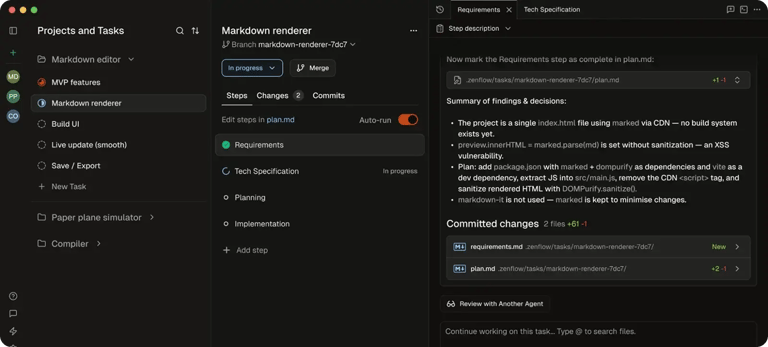
These agents operate in parallel, share context, and follow requirements to stay aligned with the original goal. Instead of manually coordinating each step, the system executes the full development workflow automatically, with built-in checks ensuring the final output meets expected standards.
Agentic AI: Key Benefits and Challenges
Agentic AI offers powerful advantages but also introduces important risks that organizations must carefully manage:
Benefits:
Here are the key benefits of Agentic AI:
- Workflow automation – Agentic AI enables businesses to automate complex workflows, improving efficiency and scalability. This allows organizations to respond quickly to change while freeing employees to focus on higher-value work.
- Adaptive intelligence – Unlike traditional automation, agentic AI can analyze data, predict outcomes, and adjust actions independently. This results in more agile operations and smarter, real-time decision-making.
- Continuous optimization – By continuously learning and optimizing processes, agentic AI reduces operational costs and accelerates return on investment. It also minimizes manual errors and improves overall performance as demand grows.
- Enhanced customer experience – Agentic AI enhances decision-making and customer experience by using data to deliver faster, more accurate, and more personalized interactions. This helps businesses stay competitive and build stronger relationships with customers.
Challenges:
Here are the key challenges of Agentic AI:
- Governance and oversight – Agentic AI requires strong governance to ensure its actions align with business goals and ethical standards. Without proper oversight, it can behave unpredictably and introduce operational risks.
- Bias and decision risks – These systems can generate incorrect or biased decisions if trained on incomplete or flawed data. Their lack of human judgment may lead them to prioritize speed or efficiency over accuracy and ethics.
- Accountability gaps – Over-reliance on AI can reduce accountability, especially in high-stakes decisions. Implementing human-in-the-loop controls is necessary to maintain oversight and responsibility.
- Data privacy and security – Agentic AI raises significant concerns about data privacy and security due to its access to sensitive information. Organizations must enforce strict protections and comply with regulations to prevent data misuse.
Implementing Agentic AI with Zencoder
After exploring these agentic AI examples, it’s clear how powerful these systems can be in theory. However, turning agentic AI architecture into something reliable in real-world workflows is where most teams struggle.
That’s where Zencoder can help you.
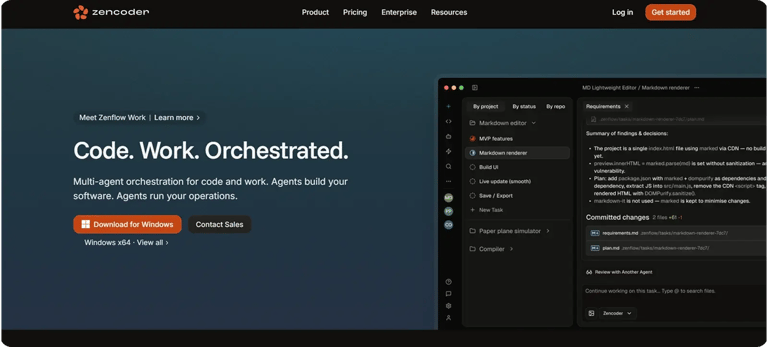
Zencoder applies agentic AI directly to software engineering by combining a deep understanding of codebases with coordinated multi-agent execution. Instead of relying on a single AI assistant, it enables a system of specialized agents that can collaborate across your entire development lifecycle.
Powered by its Repo Grokking™ technology, Zencoder builds a detailed understanding of your codebase – its architecture, dependencies, and internal patterns. This allows its agents to generate changes that are aligned with your existing code and standards.
What makes Zencoder particularly effective is how it operationalizes agentic workflows in real environments:
- Event-driven automation – Agents respond instantly to changes in tools like GitHub, Jira, or CI pipelines, taking action without manual intervention.
- Specialized multi-agent collaboration – Different agents handle coding, testing, reviewing, and refactoring in parallel, improving speed and reliability.
- Built-in validation and safety – Every change is verified through tests, rules, and CI/CD processes before being merged or deployed.
- Continuous lifecycle support – From bug fixing and refactoring to test generation and documentation, agents actively maintain and improve your codebase over time.
Sign up with Zencoder today and let autonomous agents handle your code, testing, and deployments so your team can build faster with less manual work.

FAQ
1. What are the main types of agentic AI?
There are five main types of AI agents: simple reflex, model-based reflex, goal-based, utility-based, and learning agents. Each type varies in complexity, from basic rule-following systems to advanced agents that can learn, adapt, and make decisions over time.
2. How is agentic AI different from traditional AI automation?
Traditional AI automation follows predefined rules and workflows, while agentic AI can make decisions and take actions on its own. Instead of just executing tasks, it can plan, adapt, and respond to changing conditions in real time.
3. How do multiple AI agents coordinate without conflicting with each other?
Multiple AI agents coordinate through orchestration systems that manage their roles, priorities, and shared context. These systems help prevent conflicts by aligning agent actions, resolving overlaps, and ensuring they work toward the same goal.