Did you know that Gartner predicts that by 2028, at least 15% of day-to-day work decisions will be made autonomously by AI agents, compared to almost none today? This shift reflects a move away from single, isolated AI models toward networks of specialized agents working together. As these agent-based systems scale and complexity increases, there is a need to coordinate how agents communicate, collaborate, and make decisions. In this article, we will explore everything you need to know about multi-agent orchestration and its importance in modern agent-based AI systems.

Key Takeaways
- Multi-agent orchestration is about coordination, not the number of agents
The value comes from how agents share context, communicate, and stay aligned on a common goal. Without orchestration, agents are just disconnected tools that increase complexity rather than reduce it.
- Complex work breaks single-agent systems fast
Single-agent setups work for simple, linear tasks, but they struggle with parallel work, changing conditions, and cross-functional workflows. Multi-agent orchestration shines when problems need specialization, concurrency, and ongoing collaboration.
- Orchestration must handle planning, governance, and learning together
Effective systems do more than assign tasks. They translate intent into plans, match work to capabilities, monitor execution, enforce policies, and learn from outcomes so the system improves over time.
- Different orchestration models fit different levels of uncertainty
Centralized and hierarchical models work best for predictable workflows, while adaptive and emergent orchestration handle fast-changing or ambiguous environments. Choosing the right model is a design decision that directly affects reliability and scalability.
- Zenflow turns multi-agent orchestration into a real execution system
Zencoder’s Zenflow moves orchestration out of theory and into production by enforcing structured workflows, role-based agents, automated verification, and human-in-the-loop controls. The result is multi-agent systems that are governed, observable, and safe to run at enterprise scale.
What Is Multi-Agent Orchestration?
Multi-agent orchestration is the process of designing and managing systems in which multiple AI agents work together as a coordinated team. While each agent may have a specific role, their true value lies in how they interact, share information, stay aligned, and coordinate their actions toward a common goal.
By combining their complementary strengths within one framework, the system can solve complex problems more efficiently and consistently than any individual agent could on its own.

Each multi-agent system consists of several core components. Together, these elements allow AI agents to communicate, coordinate, and work toward shared outcomes.
|
Component |
Description |
|
AI agents |
Individual software programs or automation tools designed to perform specific tasks independently, such as answering customer questions, processing transactions, or analyzing data |
|
Orchestration system |
The central layer that manages and coordinates agents by assigning tasks, overseeing workflows, monitoring progress, and resolving conflicts |
|
Communication methods |
The mechanisms that allow agents to exchange information and instructions using clear, reliable protocols for consistent interaction |
|
Shared knowledge base |
A common repository of information, rules, and context that all agents can access, helping them stay aligned on business processes, policies, and customer history |
Single-Agent vs. Multi-Agent Orchestration
Both single-agent and multi-agent orchestration aim to automate tasks and improve outcomes using AI, but they differ in how they manage complexity and collaboration.
|
Aspect |
Single-Agent Orchestration |
Multi-Agent Orchestration |
|
Core structure |
One central AI agent plans and executes all work |
Multiple AI agents collaborate as a coordinated team |
|
Handling complexity |
Manages tasks sequentially or through internal planning |
Breaks complex problems into parallel, specialized efforts |
|
Use of other agents |
Other agents may be used as tools or data sources |
Agents are peers with awareness of each other |
|
Collaboration |
No true collaboration or shared strategy |
Active collaboration with shared goals and context |
|
Communication |
One-way calls to tools or resources |
Rich, ongoing communication (direct or via shared state) |
|
Decision-making |
Centralized in a single planner |
Distributed across agents, often guided by an orchestrator |
|
Best suited for |
Simpler workflows or tightly controlled processes |
Complex, dynamic problems requiring coordination |
How Multi-Agent Orchestration Works
Instead of executing tasks on their own, agents are guided by shared rules, mutual awareness, and real-time context. Below is a clear explanation of how this process works:
1. Understanding Intent
Every orchestration starts with the user’s request. The conversational layer interprets natural language input, manages ambiguity or errors, and asks follow-up questions when information is missing. By the end of this step, the system produces a clear, structured representation of the user’s intent that other components can rely on.
2. Planning the Work
Once the intent is understood, the planner turns it into a concrete execution plan. It breaks down the request into smaller tasks, establishes the correct sequence, identifies dependencies, and prepares fallback options to handle potential failures. At the same time, it ensures all actions align with enterprise rules and policies.
3. Matching Work to Capabilities
After the plan is defined, the system determines who should do what. Each task is routed to the agent with the right skills, permissions, and context to execute it effectively. Access controls and governance checks are enforced automatically to minimize risk, satisfy compliance requirements, and produce a clear audit trail of every assignment.
4. Coordinated Agent Collaboration
The agents exchange context through shared memory, interact with enterprise tools and APIs, and execute tasks either sequentially or in parallel. When results conflict or overlap, the system reconciles them to stay on track. This collaborative approach allows orchestration to remain flexible, responsive, and aligned with business goals.
5. Oversight, Controls, and Human Judgment
As work progresses, the orchestration layer actively supervises execution. It identifies failures early, adapts task assignments as conditions change, and records every decision for full traceability.
Guardrails, such as access controls, policy enforcement, and continuous monitoring, are built directly into the workflow. When uncertainty rises, or decisions carry higher risk, human reviewers can step in to approve, redirect, or halt actions in real time.
6. Learning at the System Level
The final stage focuses on improving the system with each run. Results, feedback, and corrections are captured in shared memory, feeding back into future planning and execution. Human interventions become training signals, allowing the system to internalize best practices and user preferences. Over time, this creates a durable layer of institutional knowledge.
Different Types of Multi-Agent Orchestration
There’s no single way to coordinate multiple agents. The right approach depends on the nature of the work, its complexity, and the level of oversight or adaptability required. Below are the four most common orchestration styles.
1. Centralized Orchestration
In centralized orchestration, a single controller guides all agents. This makes it easier to keep work consistent and closely managed, which works well for clear and predictable tasks. The downside is that, as the system grows, this central controller can slow things down or become a single point of failure if it stops working.

Example of Centralized Orchestration
Imagine a customer support automation system run by one central controller. A user submits a support request. The central orchestrator reads the request, decides what needs to happen, and then assigns tasks to different agents:
- One agent pulls the customer’s account details
- Another checks recent orders
- A third drafts a response
Each agent waits for instructions and reports results back to the same central orchestrator. The orchestrator reviews everything, decides the next step, and sends the final response to the customer.
2. Hierarchical Orchestration
Hierarchical orchestration organizes agents into levels. A top-level orchestrator sets the overall direction, while mid-level agents or sub-orchestrators handle specific parts of the work. This setup makes it easier to scale and allows decisions to be made closer to where the work happens, while still staying aligned with the bigger goal.
Example of Hierarchical Orchestration
Think of a large e-commerce platform handling an order. A top-level orchestrator receives the order, defines the overall process, and delegates tasks to specialized sub-orchestrators:
- One manages payment processing
- Another handles inventory and fulfillment
- Another oversees shipping and delivery
Each sub-orchestrator coordinates its own agents and makes local decisions, such as retrying a failed payment or choosing a shipping carrier. The top-level orchestrator only steps in to handle exceptions or track overall progress.
3. Adaptive Orchestration
Adaptive orchestration allows agents to adjust their work as situations evolve. Instead of following a fixed plan, the system adjusts roles, task order, and priorities in real time based on new information. This makes it especially useful for environments where conditions change quickly or requirements aren’t fully known in advance.
Example of Adaptive Orchestration
Consider a real-time incident response system:
- An alert comes in about unusual activity.
- Agents begin investigating, but as new data appears, priorities shift.
- One agent may stop analysis and focus on containment, while another takes over deeper investigation.
- If the situation escalates, additional agents are automatically brought in.
4. Emergent Orchestration
Emergent orchestration gives agents significant freedom. Instead of working from a detailed plan, agents organize themselves, share what they learn, and figure out solutions together. The system provides only light guidance, allowing new patterns and approaches to emerge naturally. This works best in situations where problems are unclear, fast-changing, or require creativity.
Example of Emergent Orchestration
Imagine a research or innovation lab exploring a new problem:
- Agents start with a general goal, not a step-by-step plan.
- One agent explores possible ideas, another tests assumptions, while others gather data or experiment with prototypes.
- As agents share findings, new directions emerge, and roles shift naturally.
- Promising approaches gain more attention, while weaker ideas fade away.
Benefits and Challenges of Multi-Agent Orchestration
While multi-agent orchestration unlocks significant benefits, it also introduces new challenges that organizations must manage carefully as they scale.
Benefits:
- Easy scaling as you grow – Many automation systems slow down or break as they get bigger. With orchestration, new agents can be added easily and work together smoothly, allowing intelligence to scale alongside the business.
- More reliable systems – Single-agent setups create weak points that can bring operations to a halt. Orchestrated systems spread the work across multiple agents, so if one fails, the system keeps running.
- Faster response to change – Business conditions change quickly, from new regulations to sudden spikes in demand. Orchestration lets agents shift responsibilities, use new information, and adapt in real time without rebuilding the entire system.
- Shared learning across the organization – Orchestrated agents don’t work in isolation; they share context, remember past actions, and learn together. Over time, this creates a living source of knowledge built directly into everyday operations.
Challenges:
- Trust and reliability – Even advanced agents can behave unpredictably, producing errors or conflicting results. In an orchestrated system, these issues can spread quickly unless there is constant monitoring, clear decision rules, and reliable fallback mechanisms.
- Governance and compliance – As more agents interact, data moves across systems, and regulations become harder to enforce consistently. The challenge is to make governance automatic and continuous while maintaining the right balance between agent independence and human oversight.
- Cost and return on investment – Orchestration requires compute power, integration work, and ongoing human involvement. Without clear efficiency gains and well-scoped pilots, costs can rise faster than value, making it harder to justify expansion.
- Scaling and system compatibility – Solutions that work in small pilots often struggle at enterprise scale, where latency, debugging, and cascading failures emerge. Avoiding vendor lock-in and designing for modular, interoperable systems from the start is key to staying flexible over time.
Turning Multi-Agent Orchestration into an Execution System with Zencoder
Multi-agent orchestration is effective only when coordination, verification, and governance are enforced at runtime, not merely described in architecture diagrams. Many systems acknowledge the need for orchestration but still rely on ad-hoc prompts, loosely coupled agents, or manual oversight to keep work aligned. This gap between orchestration theory and execution is where Zencoder focuses its approach.
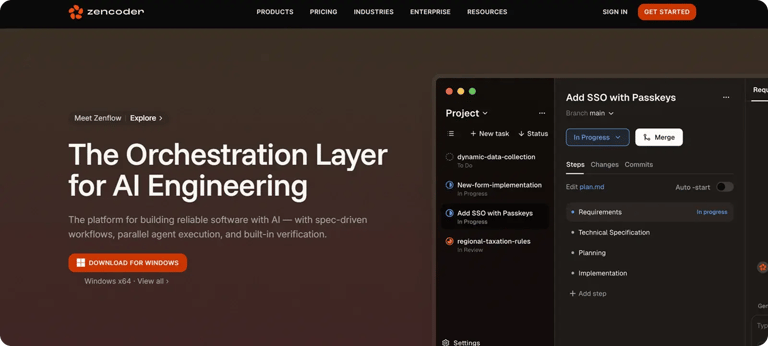
Zencoder’s orchestration layer, Zenflow, implements multi-agent orchestration by embedding structured workflows, shared context, and verification steps into the execution model. Instead of loosely coupled agent calls, Zenflow coordinates specialized agents to work within defined plans, applies automated checks, and provides human-in-the-loop controls so tasks are carried out in a governed, observable manner.
How Zenflow Uses Multi-Agent Orchestration
- Workflow-defined orchestration – Zenflow replaces prompt-based coordination with explicit workflows. Each workflow defines the sequence of steps, required artifacts, agent roles, and decision points, ensuring agents operate within a shared execution plan rather than improvising independently.
- Role-specialized agents – Instead of using a single general-purpose agent, Zenflow coordinates multiple specialized agents, such as planning, coding, testing, review, and verification agents, each responsible for a clearly defined phase of work.
- Spec- and context-aware execution – Agents operate with direct access to specifications, requirements, architecture documents, and prior outputs. This shared context ensures continuity across steps and prevents loss of intent as work moves between agents.
- Parallel task execution with isolation – Zenflow allows multiple agents and tasks to run concurrently in isolated environments. Independent steps can be executed in parallel without introducing conflicts, enabling scale while preserving correctness.
- Automated verification as a first-class step – Verification is built into every workflow. Dedicated verifier agents run tests, security checks, and spec validations automatically, blocking progression when outputs fail to meet defined criteria.
- Controlled escalation and retries – When failures occur, Zenflow can retry steps, route work to alternative agents, or escalate to human review based on predefined rules, preventing silent errors or uncontrolled divergence.
- Human-in-the-loop checkpoints – Engineers can review outputs, approve transitions, or inject guidance at specific workflow stages without restarting execution or breaking shared context.
- Full traceability and auditability – Every agent action, decision, artifact, and verification result is recorded, providing a complete audit trail for governance, compliance, and post-hoc analysis.
Contact us today to discover how Zencoder brings structure, safety, and execution discipline to multi-agent orchestration.