Multi-agent orchestration patterns are structured ways of coordinating multiple AI agents to collaborate, share tasks, and solve complex problems efficiently.
Each pattern is different and fits specific use cases, depending on factors such as task complexity, communication flow, and the level of autonomy required. In this article, we will explore six multi-agent orchestration patterns to help you choose and apply the right approach to your systems.

Key Takeaways
- Multi-agent systems make complex workflows actually manageable
By splitting work across specialized agents that collaborate and share context, you can handle tasks that would be too large, messy, or dynamic for a single model to manage effectively.
- The orchestration pattern you choose shapes everything
Each pattern comes with its own tradeoffs. Sequential pipelines provide control, while orchestrator-worker setups enable structured delegation. Choosing the wrong pattern can lead to slower performance, inefficiencies, and even system failure.
- Specialization + parallel execution = better performance
Systems that let agents focus on specific roles and run tasks in parallel can reduce latency and improve output quality, especially for analysis, generation, and decision-making tasks.
- Most systems fail at execution, not design
On paper, orchestration patterns look clean. In practice, they fall apart due to weak coordination, poor context sharing, lack of validation, and no clear way to handle errors or retries.
- Zencoder bridges the gap between theory and production
Zencoder’s Zenflow turns these patterns into structured, reliable workflows with built-in verification, shared context, and human checkpoints. Instead of fragile prompt chains, you get a system that’s controlled, observable, and actually works at scale.
What Is Multi‑Agent Orchestration?
Multi-agent orchestration is the coordination of multiple AI agents to complete tasks that are too complex for a single agent. Instead of operating independently, these agents communicate, share context, and collaborate through a central orchestration system that assigns tasks, manages interactions, and handles failures.
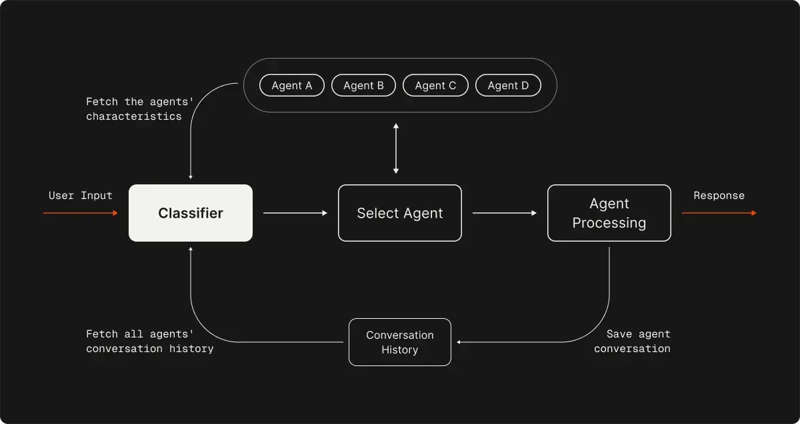
6 Multi‑Agent Orchestration Patterns
Below are six commonly used multi-agent orchestration patterns, each suited to different tasks, performance needs, and system constraints:
1. Sequential Pipeline
In a sequential pipeline, agents run in a fixed, step-by-step sequence. Each agent receives the output of the previous stage, processes it, and passes the result forward, similar to an assembly line where each step builds on the last.
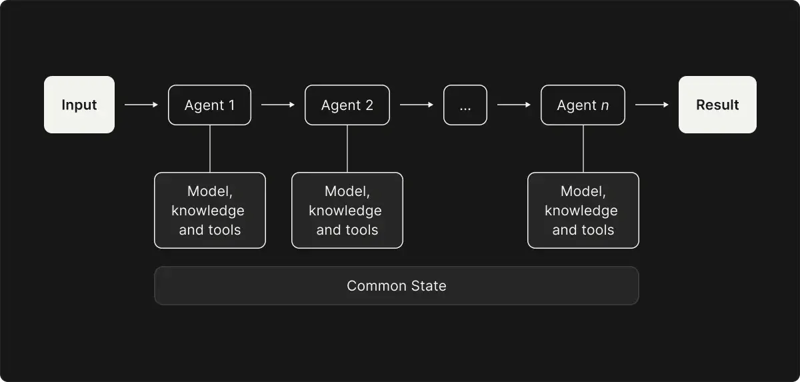
This pattern is ideal for multi-stage workflows with clear, linear dependencies, where each step must be completed before the next can begin. Because the execution order is defined upfront by the system designer, the flow remains predictable and controlled, allowing each agent to focus solely on its assigned task.
For example, imagine a system that automatically generates a blog post. It uses a sequential pipeline with several agents, each responsible for one step:
- Research agent – Gathers relevant information on the topic
- Outline agent – Organizes the key points into a structured outline
- Writing agent – Turns the outline into a full draft
- Editing agent – Improves clarity, grammar, and flow
- Formatting agent – Prepares the final version for publishing
|
When to Use It |
When Not to Use It |
|
The workflow has clear, linear dependencies, and each step must follow a fixed order. |
The workflow needs to adapt dynamically based on intermediate results. |
|
Each stage can be defined with a clear input and output contract. |
You need branching, backtracking, or error recovery between stages. |
|
Predictability, observability, and ease of optimization are priorities. |
Early-stage errors are likely and could negatively affect all downstream stages. |
|
The task fits a structured, repeatable process such as document processing, contract generation, or content creation. |
Cumulative latency across many stages would make the system too slow. |
|
You want a simple design that is easy to test, monitor, and debug. |
The problem requires more flexible coordination patterns, such as dynamic handoff or orchestrator–worker. |
2. Orchestrator-Worker
In an orchestrator-worker pattern, a central orchestrator agent manages the overall workflow by breaking a task into smaller subtasks, assigning them to specialized worker agents, and combining their outputs into a final result.
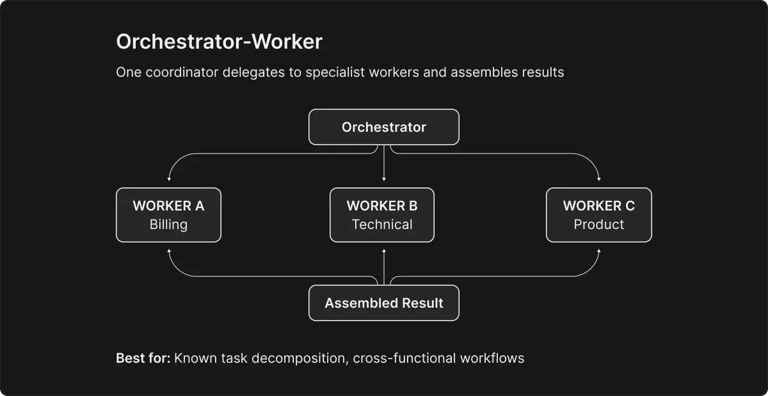
The orchestrator acts like a supervisor. It decides what needs to be done, chooses the right worker for each task, and ensures everything comes together coherently. This pattern is ideal for workflows that can be clearly decomposed into separate responsibilities, especially when different subtasks require different expertise.
For example, imagine a bank support system that helps employees respond to internal questions. It uses an orchestrator-worker design with one coordinating agent and several specialist workers:
- Orchestrator agent – Receives the request, classifies the problem, breaks it into subtasks, and delegates work
- Billing worker – Handles payment issues, charges, invoices, and account balances
- Technical worker – Resolves system errors, login problems, and troubleshooting requests
- Product worker – Answers questions about financial products, features, and policies
- Response assembly agent – Combines the workers’ outputs into one clear, final answer for the user
|
When to Use It |
When Not to Use It |
|
The workflow can be divided into clear subtasks assigned to specialist agents. |
The task cannot be easily decomposed into clear subtasks. |
|
Different parts require different expertise, tools, or knowledge sources. |
A central orchestrator becomes a bottleneck or single point of failure. |
|
You want centralized coordination and a single accountability point. |
Misclassification or poor delegation could significantly affect results. |
|
Cost optimization is important (cheap workers handle most execution). |
The workflow requires heavy peer-to-peer collaboration instead of top-down control. |
|
The process mirrors real-world team structures (triage → specialist). |
Large context sharing between workers risks exceeding token limits. |
|
You need structured delegation with predictable control over execution. |
Scaling the system would make orchestration too complex or expensive. |
3. Fan-Out/Fan-In
In a fan-out/fan-in pattern, a dispatcher agent sends the same or related input to multiple agents at the same time (fan-out). Then, a collector agent gathers and combines their outputs into a final result (fan-in). Each agent works independently, without passing results to one another, and the final answer is produced by aggregating their responses through voting, weighting, or LLM-based synthesis. This pattern is ideal for problems that benefit from multiple perspectives or parallel execution.
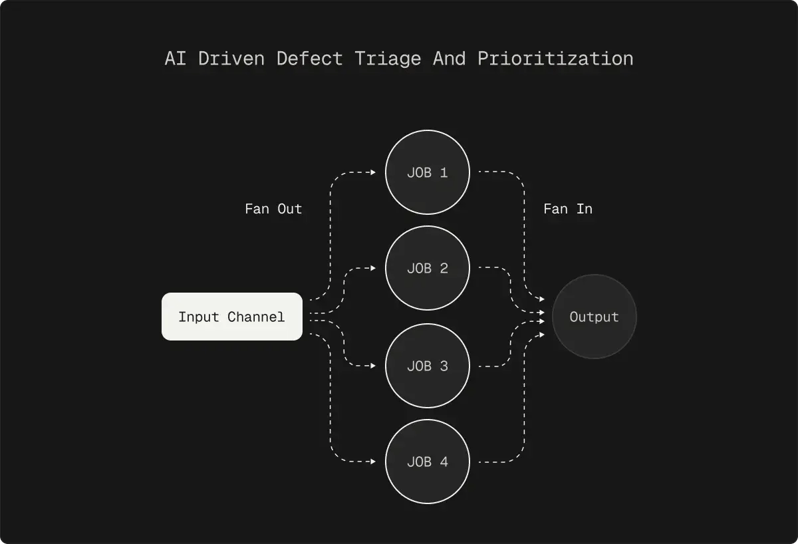
For example, a hospital triage assistant can use a fan-out/fan-in design to quickly review a patient case from several specialist perspectives at the same time:
- Dispatcher agent – Sends the same patient case summary, symptoms, lab results, and vital signs to multiple specialist agents simultaneously
- Internal medicine agent – Reviews the case for general medical causes and likely diagnoses
- Infectious disease agent – Checks whether the symptoms match bacterial, viral, or other infectious conditions
- Cardiology agent – Evaluates whether the signs could point to a heart-related issue
- Risk scoring agent – Estimates urgency level based on vitals, lab abnormalities, and known warning signs
- Collector agent – Combines all specialist outputs into a final triage recommendation, such as “urgent evaluation,” “specialist referral,” or “routine follow-up.”
|
When to Use It |
When Not to Use It |
|
Tasks can be executed independently and in parallel. |
Tasks depend on sequential steps or intermediate outputs from other agents. |
|
Multiple perspectives or approaches improve the final result. |
Combining conflicting outputs would be difficult or unreliable. |
|
Low latency is important, and parallel execution reduces total runtime. |
API rate limits or resource constraints make concurrency impractical. |
|
The problem benefits from diversity (e.g., analysis, review, brainstorming). |
A single, deterministic answer is required without ambiguity. |
|
You can design a reliable aggregation strategy (voting, ranking, synthesis). |
Aggregation logic is unclear or prone to hallucination or bias. |
4. Dynamic Handoff
In a dynamic handoff pattern, agents transfer control to one another based on the context of the task as it evolves. There is no central orchestrator; each agent decides whether it can handle the request or should pass it to a more suitable agent. Only one agent is active at a time, and the task moves through the system as a chain of handoffs. It closely mirrors real-world support systems, in which an initial contact may attempt to resolve an issue but also escalate or redirect it when necessary.
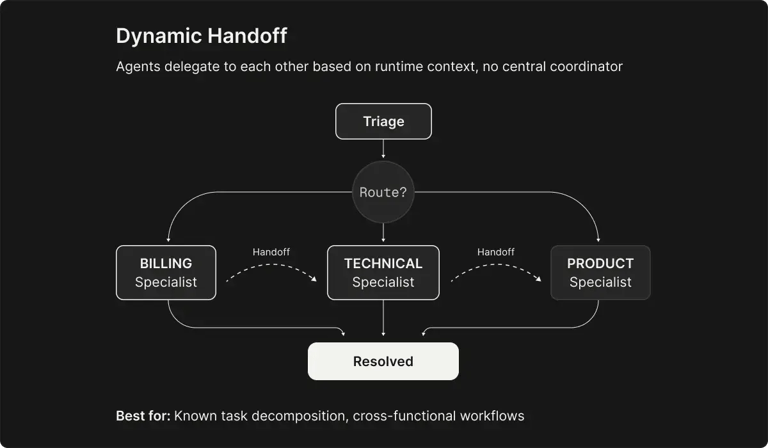
For example, imagine a telecommunications customer support system that routes requests dynamically:
- Triage agent – Interprets the user’s request and attempts initial resolution
- Technical infrastructure agent – Handles network outages, connectivity, and service issues
- Billing agent – Resolves payment problems, charges, and disputes
- Account access agent – Manages login issues, permissions, and identity verification
- Human escalation agent – Takes over when no AI agent can fully resolve the issue
Each agent can either solve the problem or pass it to another agent based on what it discovers during processing.
|
When to Use It |
When Not to Use It |
|
The correct processing path is unknown upfront and emerges during execution. |
The workflow requires a predefined, predictable sequence of steps. |
|
Tasks require flexible, context-driven routing between agents. |
You need strict control, observability, and reproducibility of execution. |
|
The system should mimic real-world escalation or triage processes. |
Debugging and traceability are critical and must be consistent. |
|
Only one agent needs to be active at a time. |
Parallel execution would significantly improve performance. |
|
Agents need full control and context when handling a task. |
Context transfer between agents would be too costly or lossy. |
|
The workflow must adapt dynamically to user input or intermediate results. |
The risk of routing loops or inconsistent paths cannot be tolerated. |
5. Hierarchical
In a hierarchical pattern, agents are organized in a tree-like structure with multiple levels of responsibility. A top-level manager agent defines the overall strategy and breaks the task into high-level goals. Mid-level supervisor agents translate those goals into actionable plans, and lower-level worker agents execute specific tasks. Each level operates within its own scope, maintaining only the context relevant to its responsibilities.
For example, imagine a system automating software development in a large organization:
- Top-level manager (Project manager agent) – Defines the overall goal and strategy (e.g., “build a dashboard”)
- Feature lead agents (Mid-level supervisors) – Break the goal into components like authentication, data visualization, and API integration
- Worker agents – Execute tasks such as coding, testing, and security review within each feature area
- Aggregation layer – Summarizes outputs from each branch and ensures alignment with the original objective
Each branch operates semi-independently, allowing the system to handle complex projects without overwhelming any single agent.
|
When to Use It |
When Not to Use It |
|
The problem is large and complex, requiring decomposition across multiple levels. |
The task is simple enough to be handled by a single agent or a flat structure. |
|
You need to scale beyond a single agent’s context window. |
Latency must be minimal and cannot tolerate multi-level coordination. |
|
Tasks can be grouped into logical subdomains or modules. |
Designing and maintaining the hierarchy would be too complex. |
|
You want to mirror organizational structures (manager → supervisor → worker). |
Information loss from summarization between levels is unacceptable. |
6. Multi-Agent Debate
In a multi-agent debate pattern, multiple agents collaborate within a shared conversation to solve problems, critique outputs, or reach consensus. A chat manager coordinates interactions by deciding which agent speaks next and managing the flow of the discussion. Agents can take on different roles, such as generating ideas, reviewing outputs, or challenging assumptions, and interact in structured or free-form ways.
For example, imagine a payment platform (such as a bank or e-commerce system) using multiple agents to decide whether to approve or block a transaction:
- Chat manager agent – Coordinates which agent analyzes the transaction next and manages the decision flow
- Transaction analysis agent – Flags a payment as suspicious (e.g., large amount from a new device) and examines patterns like location, amount, and history
- Behavioral risk agent – Adds context by comparing the activity to the user’s normal behavior (e.g., recent travel may explain location change)
- Risk scoring agent – Assigns a medium risk score based on combined signals
- Policy & compliance agent – Ensures rules are followed, noting that transactions above a certain threshold require review or action
- Agents (collectively) – Challenge each other’s conclusions, questioning whether the transaction is truly fraudulent or simply unusual but legitimate
- Final decision step – Refines the outcome by approving the transaction with additional verification (e.g., OTP) instead of blocking it
- Human fraud analyst (optional) – Reviews borderline cases if agents cannot reach a confident decision
|
When to Use It |
When Not to Use It |
|
Tasks benefit from multiple perspectives, critique, or consensus-building. |
A single, fast, deterministic answer is required. |
|
You want to reduce errors through cross- checking and validation. |
Latency must be minimal and cannot support multiple interaction rounds. |
|
The workflow involves review, QA, compliance, or policy alignment. |
The problem does not require debate or iterative refinement. |
|
Human-in-the-loop collaboration is part of the process. |
Too many agents would create excessive complexity or context growth. |
From Orchestration Patterns to Production Execution with Zencoder
As multi-agent systems continue to grow in complexity, selecting the right orchestration pattern is only the starting point. The real challenge is making those patterns work reliably in production. Despite well-defined architectures, many implementations still rely on brittle prompt chains, implicit coordination, and manual intervention. What looks structured on paper often breaks down at runtime, where consistency, validation, and control are hardest to enforce.
This is the gap Zencoder is designed to close.
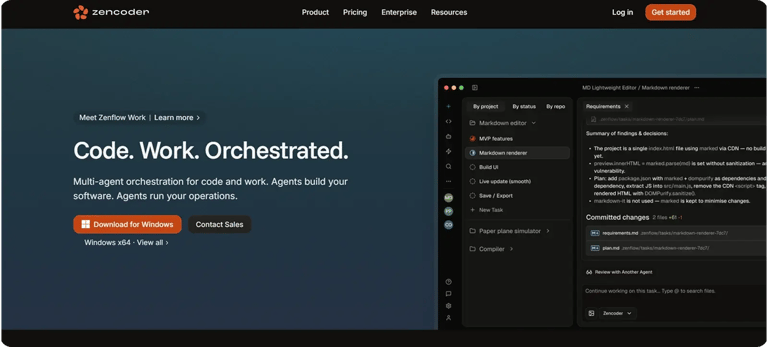
Zencoder’s orchestration layer, Zenflow, operationalizes multi-agent systems by embedding structured workflows, shared context, and verification directly into execution. Instead of chaining independent agent calls, Zenflow coordinates specialized agents within defined plans, applies automated checks at each stage, and introduces human-in-the-loop controls where needed, ensuring that workflows are not only executed, but governed and observable.
Here is how Zenflow implements multi-agent orchestration:
- Workflow-defined orchestration – Zenflow replaces loose, prompt-based coordination with clear, structured workflows. Each workflow outlines the steps to follow, the required inputs and outputs, the roles of each agent, and key decision points. This keeps all agents aligned under a shared plan, rather than having them act independently or improvise.
- Spec- and context-aware execution – Agents work with direct access to specifications, requirements, architecture documents, and previous outputs. By sharing this context, they can maintain the original intent throughout each stage, reducing misalignment and preventing work from drifting as it passes between agents.
- Role-specialized agents – Instead of relying on a single general-purpose agent, Zenflow coordinates a set of specialized agents for planning, coding, testing, reviewing, and verifying. Each agent focuses on a clearly defined phase of the workflow, leading to more structured, efficient, and reliable outcomes.
- Parallel task execution with isolation – Zenflow enables multiple agents and tasks to run concurrently in isolated environments. Independent steps can run in parallel without interfering with one another, enabling efficient scaling while maintaining accuracy.
- Controlled escalation and retries – When something goes wrong, Zenflow can retry tasks, assign them to different agents, or escalate them for human review based on predefined rules, avoiding silent failures and keeping work on track.
- Automated verification as a first-class step – Verification is built into every workflow. Dedicated verifier agents automatically run tests, security checks, and spec validations, stopping progress if results don’t meet the required standards.
- Human-in-the-loop checkpoints – Engineers can step in at key stages to review outputs, approve next steps, or provide guidance, without disrupting the workflow or losing shared context.
Try Zencoder for free today and turn multi-agent orchestration patterns into reliable, production-ready workflows.

FAQ
1. How do you choose the right multi-agent orchestration pattern?
The right pattern depends on the task structure, flexibility needs, latency constraints, and the amount of coordination required between agents. In practice, teams often combine patterns to balance control, performance, and adaptability.
2. Can multiple orchestration patterns be combined within a single system?
Yes. Most real-world systems combine multiple orchestration patterns to handle different parts of a workflow effectively. This hybrid approach improves scalability, flexibility, and overall system reliability.