Building intelligent applications hasn’t always been straightforward for developers. As systems grew more complex, there was a clear need for better ways to automate logic, coordinate tools, and handle decisions beyond simple scripts. AI workflows and AI agents emerged as solutions to these challenges, each offering its own approach to building intelligent, automated systems. Although they’re often mentioned together and used for similar goals, their design and behavior in practice can vary greatly. In this article, we will explore scalable AI workflows vs. AI agents to clarify how they work, where they differ, and which approach makes the most sense for different development scenarios.

What Are AI Workflows?
AI workflows are structured automations where AI is integrated into a series of predefined steps or rules. The workflow orchestrates calls to AI models (and possibly other tools) in a fixed sequence determined by the developer. This means the control flow is explicit: Every possible path or decision point is planned in advance, either in code or in configuration.

Key characteristics of AI workflows include:
- Predefined steps and logic: The sequence of operations is decided upfront by the developer. For example, you might design a workflow for processing support tickets that always follows the same path. First, the ticket is classified, then an AI model analyzes its sentiment, and finally, it is routed to the right team.
- High predictability and control: Because the steps are fixed, the system’s behavior is predictable and controllable. Each input will trigger a known sequence of actions, making workflows easier to test, debug, and trust in production.
- Deterministic outcomes (same input, same result): Traditional workflow automation is predictable and consistent. Even when it uses an LLM to extract information or generate text, the model is limited to a specific step. The workflow itself remains the same as it runs.
- Rule-based decision points: Decisions in a workflow are typically made using hard-coded conditions or business rules such as if/else logic. For example, an email routing workflow might specify that any email containing the word “refund” should be sent to billing support. If it contains the word “technical,” it should be sent to engineering support instead.
Common AI Workflow Patterns
Developers have identified several workflow design patterns that frequently appear when building AI-driven processes. Here are the most common ones:
1. Prompt Chaining
This pattern simplifies a complex task by breaking it into a series of LLM steps, where each step builds on the output of the previous one. For example, a document workflow might first generate an outline, then expand it into a full draft, and finally proofread or format the content in a clear, logical sequence.

2. Routing
In a routing workflow, the system uses a classifier or a set of rules to route an input to different paths. As mentioned, an AI email triage system could use a small model or rule to determine whether an incoming email is a sales inquiry, a support issue, or spam, and then route it to the appropriate next steps (or teams). Routing patterns ensure the right specialized logic is applied based on content classification.
3. Parallelization
Some workflows can perform multiple AI tasks in parallel to save time. For example, upon receiving a large PDF document, a workflow might simultaneously extract entities (names, dates, etc.) and summarize each section using separate AI calls, then merge the results. This is especially effective for workflows dealing with complex or large inputs.
What Are AI Agents?
An AI agent is an autonomous, AI-powered system that can make decisions independently to achieve a specific goal. Unlike a traditional workflow, an agent isn’t limited to a fixed sequence of steps. Instead, it can reason, plan, and adapt its behavior in real time. Given an objective, an AI agent determines the best approach, even when the steps to achieve it haven’t been explicitly defined in advance.

Key characteristics of AI agents include:
- Dynamic decision-making: Agents use AI (often an LLM) to assess the situation at each step and choose the best next action. By evaluating context and intermediate results, they reason and act adaptively. They often use approaches such as the ReAct framework, which alternates between natural-language reasoning and action.
- Autonomous tool use: AI agents can decide when and how to use external tools or APIs, such as web search, databases, or workflow systems, to achieve a goal. This enables dynamic interaction with other software, like emails sending or creating Jira tickets, without those steps being explicitly hard-coded.
- Reasoning and memory: AI agents keep track of prior steps and context, allowing them to reflect on what has happened and adjust their plan as needed. If an action fails, such as an API error, the agent can learn from it and try an alternative approach within the same run.
- Self-directed goal pursuit: You give an AI agent a high-level objective, and it determines the steps needed to achieve it. For example, when asked to book the cheapest flight, the agent can search options, compare prices, clarify details, and complete the booking on its own.
How Do AI Agents Work?
Most AI agents rely on advanced prompting techniques and planning algorithms built around LLMs. Here’s how an AI agent typically works:
1. Objective and Context
The agent is provided with an initial objective or query, such as “Help the user troubleshoot a software issue” or “Find and summarize the latest news on climate change.” It may also receive additional context, including details from the user’s profile or long-term memory from previous interactions.
2. Interpretation
The agent uses a large language model (LLM) to interpret the objective and, if needed, decompose it into smaller sub-tasks. It may plan or reason through the required steps, often using internal reasoning to decide which actions to take and in what order.
3. Planning and Tool Selection
Based on its reasoning, the agent determines the next action, such as calling an available tool or asking the user for clarification. While developers define which tools are available, the agent independently decides when and how to use them to best accomplish the task.
4. Execution, Observation, and Iteration
The agent carries out the chosen action and gathers the resulting information. It then reviews and interprets the output to decide what to do next. This cycle repeats as needed, with the agent refining its actions and asking follow-up questions until the goal is met or no further progress can be made.
AI Workflows vs. AI Agents: Key Differences
While both workflows and agents aim to automate tasks using AI, they differ significantly in how decisions are made and how much autonomy the system has. Below is a side-by-side breakdown highlighting the key areas where workflows and agents begin to diverge.
1. Decision-Making & Autonomy
AI workflows follow predefined rules, with every decision and path determined in advance. This makes their behavior consistent, but also limits their ability to adapt. AI agents, by contrast, make decisions as they run, continuously assessing the situation and choosing the next best action instead of following a fixed script.
🔴 Verdict
Workflows work best when decisions can be clearly defined upfront, and consistency is critical. Agents are the better option when the system needs to adapt, reason in real time, and handle situations that weren’t anticipated.
2. Control & Predictability
AI workflows offer a high level of control. Their behavior is transparent, predictable, and easy to audit or debug, making them well-suited for regulated or high-risk environments. AI agents, on the other hand, are more autonomous and therefore less predictable. They may take actions that weren’t explicitly anticipated, which can be powerful but also harder to anticipate, control, or test.
🔴 Verdict
When strict control, auditability, and predictability are essential, workflow-based approaches are the safer choice. If you can tolerate more uncertainty in exchange for autonomy and problem-solving ability, agent-based approaches can add significant value.
3. Complexity Handling
AI workflows can manage structured complexity, but they become difficult to maintain as conditions and edge cases multiply. When every variation needs an explicit rule, the logic can quickly grow overly complex. AI agents handle complexity differently, using reasoning and pattern recognition to deal with many possible scenarios without requiring each one to be predefined.
🔴 Verdict
When complexity can be clearly structured and controlled, workflows offer clarity and consistency. However, when the range of scenarios is large, nuanced, or hard to fully define, agents are better equipped to handle it.
4. Ease of Development & Maintenance
AI workflows typically require more upfront planning, since every step and rule must be defined in advance. AI agents are often faster to deploy, but harder to stabilize. Their behavior can shift as prompts, data, or models change, which makes testing and maintenance more iterative.
🔴 Verdict
Workflows are easier to maintain over time and offer fewer surprises. Agents enable faster experimentation but require ongoing tuning and monitoring to remain reliable.
5. Use Case Suitability
AI workflows are best for routine, structured tasks where the steps are known in advance, such as invoice processing, eligibility checks, inventory reordering, or compliance-driven approvals. AI agents are better suited to open-ended or dynamic tasks, such as customer support for unusual issues, scheduling across multiple stakeholders, troubleshooting problems, research and analysis that evolves as new information emerges, or AI demo agents that adapt a product walkthrough in real time based on how a user engages.
🔴 Verdict
Use workflows for predictable, repeatable processes. Use agents when the situation is uncertain, changes over time, or requires judgment and adaptation.
Choosing Between Scalable AI Workflows vs. AI Agents
Choosing between AI agents and AI workflows depends on how well the process can be defined in advance, how much decision-making freedom the system should have, and how it needs to behave in production.
|
Consideration |
When to Use AI Agents |
When to Use AI Workflows |
|
Process definition |
The steps cannot be fully described in advance and must be determined during execution. |
The process can be outlined in advance, with clear stages and handoffs. |
|
Level of autonomy |
The system should independently decide what to do next to reach a goal. |
The system should follow an orchestrated structure with limited freedom. |
|
Change during execution |
The environment or inputs may shift continuously, requiring ongoing adjustment. |
Change can be handled at predefined decision points. |
|
Operational safety |
Occasional unpredictability is acceptable in exchange for flexibility. |
Guardrails, approvals, and recovery mechanisms are required. |
|
Visibility & debugging |
Deep introspection into every decision is not critical. |
Clear traces, checkpoints, and logs are required for diagnosis or audits. |
|
Lifecycle focus |
Rapid prototyping or experimentation is the main goal. |
Long-term reliability, scalability, and maintainability are priorities. |
Hybrid Approaches
In many production systems, a hybrid approach combines workflows and agents to balance reliability and adaptability. A common hybrid design uses a workflow to manage the overall process and route incoming requests to specialized agents. Each agent is responsible for a specific open-ended subtask, allowing the system to remain structured while still being flexible and intelligent where it matters most.
That hybrid approach is exactly what Zencoder offers.
Zencoder: Workflow Orchestration with Autonomous Coding Agents
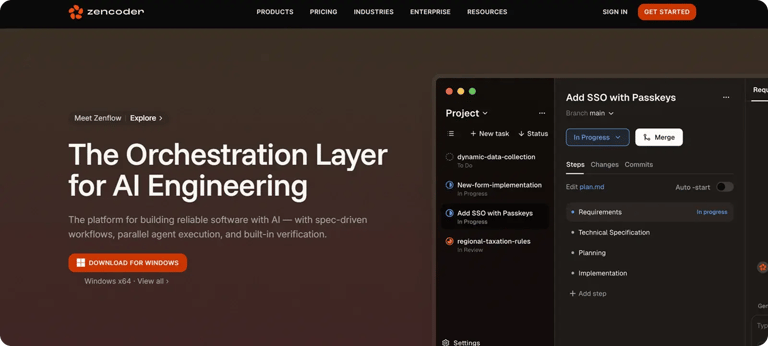
Zencoder is an AI-powered coding agent that automates end-to-end software development workflows. It combines spec-driven workflow orchestration (Zenflow) with specialized autonomous agents that can generate code, create tests, review changes, and iterate until validation passes.
Key Features:
1️⃣ Zenflow – Zenflow is Zencoder’s workflow engine for coordinating multiple AI agents inside predefined engineering processes. With Zenflow, you can:
- Execute multi-step workflows for feature development, bug fixes, and refactors
- Coordinate specialized agents (coding, testing, review, verification) within a single task
- Enforce verification steps before completion, including tests and cross-agent review
- Run parallel tasks in isolated environments to speed up delivery without conflicts
- Build from specs, PRDs, or architecture docs to keep implementations aligned with requirements

2️⃣ Autonomous coding agents – Zencoder provides customizable AI agents that operate as persistent engineering teammates. These agents can:
- Generate production-ready code aligned with existing architecture and standards
- Refactor legacy code while preserving behavior and structure
- Fix bugs linked to issues or tickets and validate changes automatically
- Review pull requests and flag logic, security, or architectural issues
- Iterate on outputs until verification criteria are met
3️⃣ Zencoder’s Repo Grokking™ – Repo Grokking enables Zencoder agents to analyze your entire codebase with a deep, context-aware understanding of structures, workflows, and custom implementations. This means your teams get precise, actionable recommendations that accelerate development, reduce errors, and improve software reliability.
4️⃣ Zentester – Zencoder uses AI to help you automate testing at every level. You can describe what you want to test in plain English, and Zentester automatically adapts as your code evolves.
Here’s what it does:
- Every layer of your application is tested at scale, from unit functions to end-to-end user journeys.
- As your codebase evolves, Zentester automatically updates your tests, eliminating the need for manual rewrites.
- Our intelligent agents understand your application’s architecture and interact seamlessly with the UI, APIs, and database.
- Zentester’s AI spots risky code paths, uncovers hidden edge cases, and creates tests based on real user behavior.
5️⃣ Multi-Repo Search – Index and search across multiple repositories so AI agents can understand and navigate complex, multi-repo architectures. Manage all your repositories from a simple web admin panel, and explore your entire indexed codebase whenever needed.
6️⃣ Security treble – Zencoder ensures enterprise-grade protection with SOC 2 Type II, ISO 27001, and ISO 42001 certifications, making it the only AI coding agent with all three.
Try Zencoder today and see AI workflows and autonomous agents working together in one seamless, end-to-end engineering system.