Autonomous agents and regular AI agents are two approaches to building intelligent systems that can analyze information, make decisions, and perform tasks on behalf of users or organizations.
If you're considering implementing AI agents, understanding the distinction between these two types is essential to choosing the right approach for your business. In this article, we'll explore autonomous agents vs. regular AI agents, explain how each works, and break down the key differences that determine where and when they should be used.

Key Takeaways
- Autonomous agents go beyond simple task execution
Unlike regular AI agents that respond to prompts or follow predefined workflows, autonomous agents can independently pursue goals, make decisions, and take action without requiring human approval at every step.
- The biggest difference is continuous planning and adaptation
Autonomous agents observe, plan, act, evaluate, and learn. This allows them to adjust to changing conditions and continue making progress even when unexpected situations arise.
- Regular AI agents are best for predictable, human-guided tasks
Chatbots, knowledge assistants, appointment schedulers, and support agents excel when workflows are structured, interactions are short-lived, and humans remain responsible for final decisions and actions.
- Autonomous agents deliver the most value in complex, multi-system workflows
They are particularly effective for areas like software development, cybersecurity, sales operations, supply chain management, and healthcare administration, where work involves multiple steps, ongoing monitoring, and coordination across different tools.
- Organizations need the right platform to put autonomous agents into production
Platforms like Zencoder's Zenflow Work help teams deploy autonomous agents that can plan, execute, and optimize workflows across tools they already use. This enables faster automation and business outcomes with less manual effort.
What Are Autonomous Agents?
Autonomous agents are software or robotic systems that can perceive their environment, make decisions, and take actions to achieve specific goals without requiring human approval at every step. Their level of autonomy ranges from simple systems like thermostats to advanced technologies such as self-driving cars, but they can all adapt their behavior based on feedback from their surroundings.
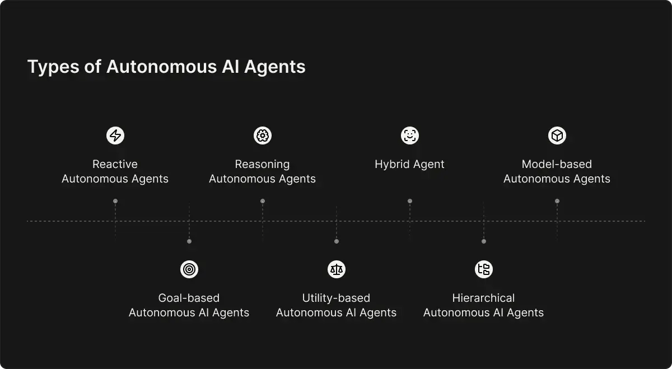
Unlike traditional scripts that fail in unexpected situations, autonomous agents can respond to new circumstances and continue operating effectively within their intended domain.
How Do Autonomous Agents Work?
At the core of every autonomous agent is a continuous cycle of sensing, reasoning, and acting. Often referred to as the agent loop, this process runs continuously until a goal is achieved or a predefined stop condition is met. The agent loop typically follows these stages:
- Observe – Gathering information from available sources, such as sensors, user inputs, databases, or APIs
- Interpret – Transforming raw inputs into a meaningful understanding of the current environment or situation
- Plan – Developing a strategy for achieving the objective, often by breaking a complex goal into smaller, manageable tasks
- Decide – Selecting the next action by dynamically generating instructions, workflows, or code based on the current context and goal
- Act – Executing the chosen action, such as making an API request, updating a database, controlling a device, or generating content
- Evaluate – Assessing the outcome of the action and determining whether it advanced progress toward the goal
- Update memory – Storing new information, outcomes, and lessons learned in working or long-term memory.
- Repeat – Continuing the cycle until the objective is completed or a stopping condition is reached
What Are Regular AI Agents?
An AI agent is a software system that can perceive information from its environment, process that information, and take actions to achieve specific goals. These agents use predefined rules, machine learning models, or a combination of both to perform tasks such as answering questions, making recommendations, or retrieving information.
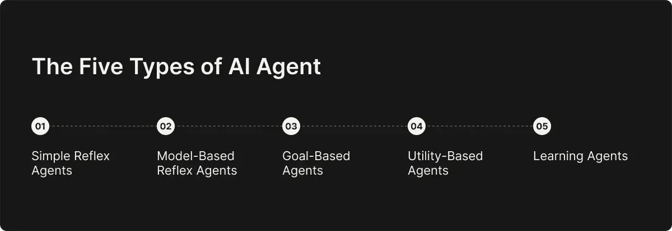
While AI agents can operate with some level of autonomy, they are typically designed for specific tasks and have more limited adaptability than autonomous agents.
How Do Regular AI Agents Work?
While this process is similar to that of autonomous agents, it is generally less complex and often relies on predefined rules, models, or workflows rather than extensive self-directed planning. A typical AI agent workflow includes the following stages:
- Perceive the environment – AI agents collect information from available sources, such as sensors, databases, APIs, or user inputs, to understand their current environment.
- Process input data – The collected information is organized and transformed into a structured representation that enables the agent to analyze and reason about it.
- Make decisions – Based on the available data, the agent evaluates the current situation and selects an appropriate action using predefined rules, statistical methods, machine learning models, or other decision-making techniques.
- Plan and execute actions – Many AI agents execute the selected action immediately with minimal planning, while more advanced agents can generate a short sequence of steps within predefined constraints.
- Learn and improve – Some AI agents incorporate feedback mechanisms that enable them to refine their performance over time. For example, a recommendation system may refine its suggestions based on user interactions and preferences.
Autonomous Agents vs. Regular AI Agents: Key Differences
While autonomous and regular AI agents are built on similar technologies, their capabilities differ across several important areas:
|
Feature |
Regular AI Agents |
Autonomous Agents |
|
Autonomy |
Depend on human instructions to define objectives and guide execution |
Pursue objectives independently and determine the actions needed to achieve them |
|
Adaptability and Learning |
Require retraining or human intervention to adapt |
Learn from experience and feedback, continuously refining their behavior over time |
|
Decision- Making and Planning |
Focus on completing immediate tasks and responding to specific inputs |
Evaluate alternatives, break goals into subtasks, and adjust plans as conditions change |
|
Memory and Context |
Typically operate on current inputs with little or no long-term memory |
Maintain memory of past interactions, decisions, and environmental states to support reasoning over time |
|
Task and Environment Complexity |
Best suited to structured tasks in stable and predictable environments |
Designed to operate in dynamic, uncertain, and open-ended environments |
|
Development Complexity and Cost |
Easier and less expensive to design, implement, and maintain |
Require more sophisticated architectures, including memory, planning, learning, and safety mechanisms |
|
Safety and Governance |
Easier to monitor and control because their scope of action is limited |
Need stronger oversight, transparency, and safeguards due to their ability to act independently |
|
Collaboration and Multi- Agent Interaction |
Usually operate independently or as part of simple workflows |
Can coordinate, negotiate, and collaborate with other agents in complex multi-agent systems |
How to Choose Between Autonomous Agents vs. Regular AI Agents
The guidelines below can help you determine when a simple AI agent is sufficient, and when a fully autonomous agent is a better choice.
When to Choose an Autonomous Agent
Consider using an autonomous agent when:
- The task involves multiple steps and decisions – The agent must gather information, evaluate options, take action, and adjust based on results throughout a workflow.
- The environment changes frequently – Conditions are dynamic and require real-time responses to new information.
- Work spans multiple systems – The process requires coordination across applications, databases, APIs, or business platforms.
- The objective is ongoing rather than one-time – The agent must continuously monitor, manage, optimize, or respond to events over time.
- Speed and scale matter – Large volumes of tasks need to be processed consistently, quickly, and with minimal human oversight.
Below are some common business scenarios in which an autonomous agent is particularly effective:
|
Use Case |
What an Autonomous Agent Does |
|
Financial Services & Insurance |
Continuously reviews applications, assesses risk, detects fraud, and processes claims, adapting decisions based on new information and evolving risk factors |
|
Supply Chain & Logistics |
Monitors inventory, coordinates shipments, responds to disruptions, and optimizes operations across multiple suppliers, warehouses, and transportation systems |
|
Software Development & IT Operations |
Manages tasks such as code generation, testing, deployment, monitoring, and incident response without requiring constant human intervention |
|
Sales & Revenue Operations |
Researches prospects, qualifies leads, personalizes outreach, schedules meetings, and updates CRM systems as opportunities move through the pipeline |
|
Healthcare Administration |
Coordinates scheduling, patient onboarding, insurance verification, and record management across multiple systems and workflows |
|
Cybersecurity Operations |
Monitors network activity, investigates threats, prioritizes incidents, and initiates response actions in real time as new risks emerge |
|
Procurement & Vendor Management |
Evaluates suppliers, compares quotes, manages purchase requests, and tracks vendor performance throughout the procurement lifecycle |
When to Choose a Regular AI Agent
Consider using a regular AI agent when:
- The interaction is primarily conversational – The goal is to answer questions, provide information, generate content, or assist users through a chat-based interface.
- The workflow follows a defined path – The process consists of predictable steps with clear rules, such as troubleshooting, onboarding, appointment scheduling, or order tracking.
- Human approval is required before action is taken – The AI can provide recommendations, information, or guidance, while a person remains responsible for making decisions and executing actions.
- Tasks are short-lived and self-contained – Each interaction has a clear beginning and end, without the need for ongoing monitoring or continuous optimization.
- Simplicity and cost-effectiveness are priorities – An AI assistant can deliver the required functionality without the complexity of a fully autonomous system.
The following examples highlight common business scenarios in which a standard AI agent is often the most practical choice:
|
Use Case |
How a Regular AI Agent Helps |
|
Customer Support & FAQs |
Answers common questions, provides relevant information, and helps users resolve routine issues through conversational interactions |
|
IT Service Management |
Guides employees through troubleshooting steps, recommends knowledge base articles, and assists with submitting or routing support requests |
|
Appointment Scheduling |
Helps users book, reschedule, or cancel appointments through a structured and predictable workflow |
|
Order Tracking & Account Inquiries |
Provides updates on order status, deliveries, subscriptions, billing information, and account-related requests |
|
User Onboarding |
Walks new users through setup, explains key features, and provides guidance throughout the onboarding experience |
|
Lead Qualification |
Collects customer information, asks qualifying questions, and routes promising opportunities to the appropriate sales teams |
|
Internal Knowledge Assistants |
Helps employees quickly find policies, procedures, documentation, and answers to common workplace questions |
Putting Autonomous Agents to Work with Zencoder
As organizations move beyond AI assistants and chatbots, they increasingly need solutions that can execute multi-step workflows, coordinate across business systems, and deliver outcomes with minimal human oversight. This is where Zencoder can help!
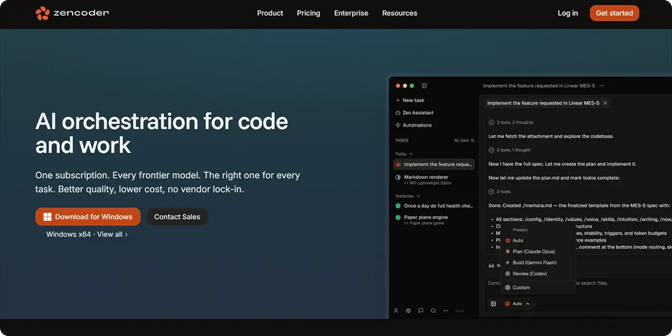
Zencoder's Zenflow Work platform enables organizations to deploy autonomous AI agents that can plan, execute, monitor, and optimize complex workflows from start to finish. Rather than requiring constant human guidance, agents operate toward defined goals, determine the necessary steps, and continue working until they achieve the objective.
The platform integrates directly with business-critical tools such as Jira, GitHub, Linear, Gmail, Google Calendar, Slack, Notion, HubSpot, Amplitude, and Datadog, allowing agents to work across existing systems without disrupting established processes.
Organizations can use Zencoder agents to automate a wide range of operational workflows, including:
- Software development & engineering – Automate sprint reporting, bug triage, release note generation, technical debt management, security audits, and feature delivery workflows across Jira, GitHub, and Linear.
- Sales & revenue operations – Research prospects, prepare meeting briefs, enrich leads, generate proposals, automate follow-up sequences, and support pipeline management activities.
- Marketing – Monitor competitors, track product launches and customer feedback, generate campaign content, maintain content calendars, and create performance reports.
- Operations & executive reporting – Generate executive dashboards, monitor budgets and expenses, manage vendor and contract workflows, streamline employee onboarding, and automate internal reporting processes. Contract-heavy work is moving the same way outside software, with AI native law firms such as General Legal pairing attorneys with AI workflows for commercial contract drafting and review.
- Customer support – Track onboarding progress, identify expansion opportunities, automate customer communications, analyze churn risks, and convert support requests into actionable engineering tasks.
To accelerate adoption, Zencoder provides a marketplace of pre-built autonomous agent templates that help organizations move quickly from experimentation to production.
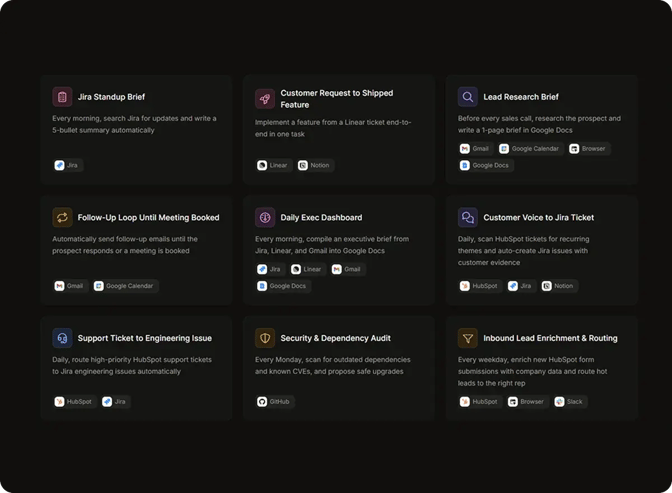
Rather than building workflows from scratch, users can start with proven automations for common business processes and customize them to match their goals, existing tools, and internal workflows. This allows cross-functional teams to deploy autonomous agents more quickly while reducing implementation complexity and time to value.
Start your free trial with Zencoder today and discover how autonomous AI agents can automate complex workflows, coordinate across your tools, and deliver outcomes with minimal human oversight.

FAQ:
1. Do autonomous agents always require human oversight?
Not necessarily. Some autonomous agents can operate independently within predefined boundaries, while others use a human-in-the-loop approach and seek approval for high-impact decisions. The appropriate level of oversight depends on the use case, risk level, and organizational requirements.
2. What is the difference between autonomous agents and traditional workflow automation?
Traditional workflow automation follows predefined rules and paths that must be configured in advance. Autonomous agents are better suited for dynamic and unpredictable environments.
3. Can autonomous agents and regular AI agents work together?
Absolutely. Regular AI agents can handle customer interactions, content generation, and information retrieval, while autonomous agents manage longer, more complex workflows. This hybrid approach combines conversational assistance with autonomous execution to improve efficiency and scalability.