According to recent industry research, over 66.4% of enterprise AI deployments now use multi-agent systems to handle complex workflows and decision-making. As organizations scale their AI capabilities, coordinating multiple specialized agents has become essential for maintaining efficiency, accuracy, and reliability. However, without a clear mechanism to direct tasks to the right agent at the right time, even the most advanced systems can become inefficient and fragmented. In this article, you’ll learn everything you need to know about AI agent routing so you can design smarter multi-agent systems, optimize task distribution, and build scalable AI workflows that deliver measurable results.

Key Takeaways
- AI agent routing is the decision layer that makes multi-agent systems work
Routing analyzes each request and directs it to the right agent, model, or workflow based on intent, complexity, cost, and risk. This prevents overloading a single general system and significantly improves reliability and performance.
- There are multiple routing approaches, each with tradeoffs
Rule-based routing is simple but limited. Semantic and intent-based routing handle language variation better but depend on strong data. LLM-based and hierarchical routing offer flexibility and scale, though they increase cost and architectural complexity.
- Scalability depends on modular design and clear agent boundaries
Well-documented agents with defined responsibilities make it easier to scale, replace, or improve parts of the system independently. A modular architecture prevents routing logic from turning into a fragile, monolithic mess.
- Monitoring, testing, and fallbacks are essential for long-term reliability
Tracking routing accuracy, latency, and error rates helps detect drift and performance issues early. Built-in fallback paths ensure users still get help when the router is uncertain.
- Routing only delivers value when execution is structured and verified
Even strong routing logic fails if agents operate without coordination. Zenflow turns routing into production-ready execution through structured workflows, isolated environments, and built-in verification.
What Is AI Agent Routing?
AI agent routing is the decision layer that determines which agent, toolset, model, or workflow should handle a user’s request. It evaluates signals such as intent, complexity, risk, and cost to ensure each task is directed to the most appropriate specialist. By delegating work instead of relying on a single generalist system, routing makes AI applications more reliable, scalable, and efficient.
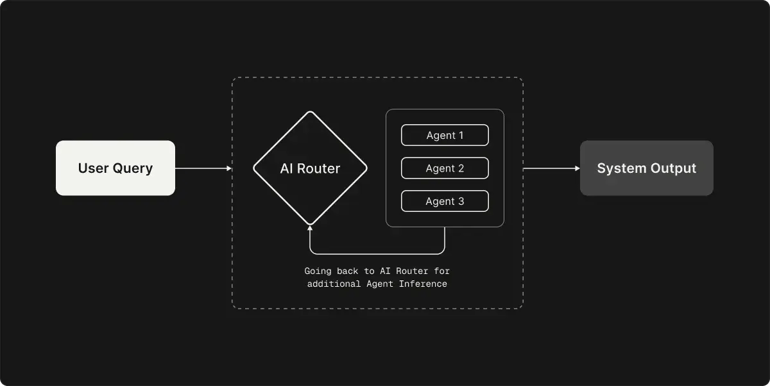
Here is how AI agent routing typically works:
1. Understand the request – The system begins by analyzing the user’s input to identify important details such as intent, topic, required actions, safety considerations, urgency, language, and user tier. This step helps clarify what the user actually needs and any constraints that may apply.
2. Choose the right path – Using those signals, the system decides how the request should be handled. It may rely on predefined rules, a language model acting as a classifier, similarity matching, or a scoring system trained on past data. Many systems also include backup options in case the first choice is not suitable.
3. Carry out the task – The selected agent, tool, or workflow then processes the request. If more than one component is involved, their outputs can be combined, checked, or ranked before the final response is delivered.
4. Improve over time – After the task is completed, the system records performance data such as response time, cost, success rate, confidence level, and user feedback. This information is used to continuously refine and improve future routing decisions.
Types of AI Agent Routing
AI agent routing can be implemented in different ways, depending on the application’s goals and complexity. Some of the most common types include:
1. Rule-Based Routing
Rule-based routing relies on predefined conditions or patterns, such as keywords or simple if-then rules, to direct queries. For example, a message that includes the word “invoice” might automatically be sent to the billing agent. This approach is straightforward and predictable, making it easy to implement and manage.
|
Challenges |
What it means in practice |
|
Limited flexibility |
The system can only handle scenarios that have been explicitly defined in advance. |
|
Sensitivity to wording |
If a user phrases something in an unexpected way or uses new terminology, the rule may not be triggered. |
|
Multiple intents |
Messages that combine more than one request may be routed incorrectly. |
2. Semantic Routing
Semantic routing directs queries based on meaning rather than exact wording. Instead of relying on keywords, it uses embeddings or a language model to match a user’s intent to the most appropriate agent. For example, “I didn’t get my package” and “Where is my shipment?” would both be routed to the shipping agent because they convey the same intent.
This approach handles language variation, such as synonyms and paraphrasing, much more effectively than rule-based systems, making it more flexible and user-friendly.
|
Challenges |
What it means in practice |
|
Depends on model quality |
If the underlying model isn’t strong or well-tuned, routing can be inaccurate. |
|
Needs domain adaptation |
In technical or specialized areas, the system may require additional training or fine-tuning to work effectively. |
|
Can confuse similar intents |
Requests that are closely related can sometimes be routed to the wrong agent. |
|
Requires good data |
High-quality examples or carefully designed prompts are often needed for reliable performance. |
3. Intent-Based Routing
Intent-based routing classifies a user’s request into a predefined category and maps each intent to a specific agent or function. For example, the system might label a request as “book_flight” or “cancel_reservation,” then trigger the corresponding handler. This approach is common in chatbots: Once the intent is identified, the appropriate agent is invoked. It offers more flexibility than simple keyword rules and works well when the expected user tasks are known in advance.
|
Challenges |
What it means in practice |
|
Limited to predefined intents |
The system can only recognize intents it has been trained or configured to detect. |
|
Dependent on labeled data |
Accurate classification depends on good training data and clear intent definitions. |
|
Hard to scale over time |
As new use cases emerge, additional intents must be defined, trained, and maintained. |
4. LLM-Based Routing
LLM-based routing uses a large language model to decide how queries should be handled. The model reads the full request, often including context, and determines which agent (or agents) should respond.
Because it understands nuance and complex language, it can break down multi-step requests. For example, a command like “Summarize last quarter’s sales and email it to my manager” could be split into two subtasks (analysis and email) and routed to the appropriate agents. This approach adapts well to new phrasing and complex instructions, making it highly flexible.
|
Challenges |
What it means in practice |
|
Higher compute cost |
Running an LLM for routing is more resource-intensive than applying rules or classifiers. |
|
Latency |
Responses may take longer due to model processing time. |
|
Prompt sensitivity |
Routing quality depends on well-designed prompts and clear instructions. |
|
Less deterministic |
Decisions may vary slightly between runs, making behavior harder to audit or control. |
|
Overscoping risk |
The model may over-interpret or decompose requests in unintended ways without guardrails. |
5. Hierarchical Routing
Hierarchical routing uses multiple layers of decision-making. A top-level router first assigns the request to a broad category, and then a secondary (more specialized) router makes a finer-grained decision within that category.
For example, a top router might classify a request as “customer support,” and a second router would then decide whether it relates to a “billing issue” or a “technical issue.” This layered approach improves scalability and organization, making it well-suited for large systems where a single routing layer would be too complex or overloaded.
|
Challenges |
What it means in practice |
|
Added complexity |
Multiple routing layers increase the complexity of system design and maintenance. |
|
Error propagation |
If the top-level router misclassifies a request, lower levels may never see the correct context. |
|
Latency overhead |
Additional routing steps can increase processing time. |
|
Harder debugging |
Tracing mistakes across layers can be more difficult than in single-layer systems. |
AI Agent Routing Benefits
Some of the main benefits of AI agent routing include:
- Modular and flexible system design – Each agent can be developed, updated, or improved independently without disrupting the entire system. This modular structure makes it easier to scale capabilities over time.
- Lower costs and better resource use – By sending each request only to the most appropriate agent, the system avoids unnecessary processing and excess token usage. This reduces API calls, improves efficiency, and keeps operational costs under control.
- Improved reliability and fewer errors – Correct routing minimizes misinterpretation and reduces the risk of irrelevant or inaccurate outputs. As a result, the system stays focused, consistent, and more dependable overall.
- Easier maintenance and long-term scalability – Clear routing logic simplifies debugging and performance optimization as the system grows. Teams can expand functionality confidently without creating a tangled, monolithic architecture.
- Smoother conversational experience – Routing preserves context across interactions, allowing follow-up questions to build naturally on previous exchanges. Instead of restarting conversations, users experience a seamless and coherent flow.
AI Agent Routing: Design Principles and Best Practices
When designing, building, or fine-tuning an AI agent routing system, you should follow proven best practices to ensure accuracy, scalability, maintainability, and long-term reliability.
Here is what you need to know:
1. Document Logic and Provide Examples
Create clear, well-structured documentation that explains:
- Purpose: What the agent is responsible for
- Inputs: What information it expects
- Outputs: What it returns
- Limitations: Which constraints or edge cases it should not handle
When working with LLM-based agents, prompts should include detailed instructions that clearly define the agent’s role and responsibilities. It’s important to spell out the decision criteria that differentiate one agent from another so the model can reliably determine which agent should handle a request. Prompts should also include multiple example queries that demonstrate common use cases, as well as edge-case examples that clarify boundaries and reduce ambiguity.
2. Use a Modular Architecture
Build the agents and the router as separate, independent components that work together but don’t rely heavily on each other (for example, like microservices or plug-in modules). Each part of the system should be able to operate, scale, and evolve without requiring changes to the entire pipeline.
A modular architecture allows you to scale specific components as demand increases. For example, running multiple instances of a frequently used agent without modifying the router. It also makes experimentation easier. You can introduce a new agent, adjust routing logic, or replace an existing component without rebuilding the whole system.
3. Monitor and Test Continuously
Instrument the router with logging and performance metrics to clearly observe how routing decisions are made and evaluated. Track key signals such as:
- Routing decisions: Which agent is selected for each query
- Accuracy: Whether the selected agent was the correct choice
- Performance metrics: Latency, error rates, and throughput
Use monitoring and evaluation tools (such as Arize Phoenix or Deepchecks) to measure routing accuracy and detect model or data drift over time. You should also regularly test the routing logic with new, ambiguous, and edge-case inputs. The goal is to challenge the system in the same ways real users will. Whenever possible, automate these tests so they run consistently and catch regressions early, without relying on manual checks.
4. Provide Fallbacks and Error Handling
No routing system is perfect, so you should always plan for uncertainty. Build in a default fallback for cases where the router isn’t confident about which agent to select. For example, you might route the query to a general assistant that asks clarifying questions, or send it to a human support team when necessary. This ensures the user still gets help instead of hitting a dead end.
Turn Multi-Agent Chaos into Coordinated Execution with Zenflow
AI agent routing is only as good as the system that executes it. You can design perfect routing logic, but if agents drift from specs, collide in the same codebase, or ship unverified outputs, the whole system breaks down. That’s where Zenflow stands out.
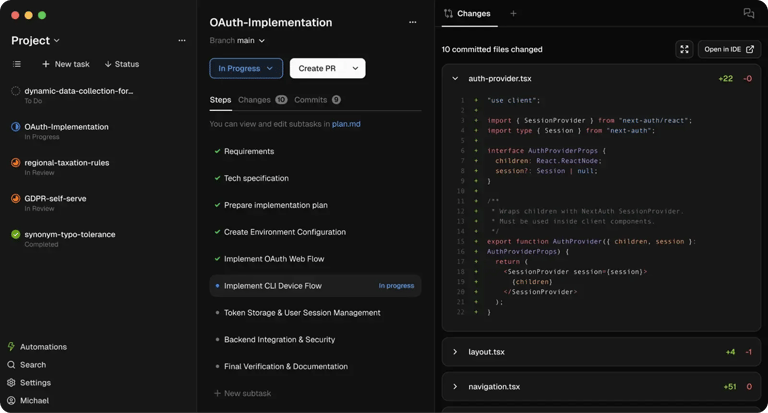
Zenflow is built for AI-first engineering teams that want to move beyond experimental multi-agent setups and into production-ready orchestration. Instead of relying on a single generalist agent, Zenflow coordinates specialized AI agents through structured, spec-driven workflows, ensuring every task is routed, executed, and verified correctly before shipping.
Here is how it works:
🟢 Step 1: Describe the work
Create a task and define what needs to be built. Choose from pre-built workflows (feature development, bug fixes, refactors) or create a custom workflow tailored to your team’s process.
🟢 Step 2: AI-guided execution
Specialized agents pick up the task and execute according to the defined workflow steps. Agents read your specs, architecture docs, or PRDs before writing code, preventing drift and misalignment.
🟢 Step 3: Parallel and isolated processing
Multiple tasks run simultaneously in isolated environments. Agents coordinate within workflows without interfering with your main codebase, eliminating conflicts and bottlenecks.
🟢 Step 4: Built-In verification
Every workflow automatically runs tests and cross-agent reviews. If something fails, agents fix it. Code only moves forward after passing all verification gates.
What Makes Zenflow Stand Out?
Most AI routing systems stop at delegation. Zenflow operationalizes execution. Here’s what that actually means for engineering teams:
- Routing becomes deterministic, not experimental – In many multi-agent setups, routing decisions feel probabilistic. Zenflow introduces structured workflows and verification gates that make execution predictable and auditable, not model-dependent guesswork.
- Agents don’t just act, they coordinate – Routing often sends tasks to isolated agents. Zenflow enables agents to share context, critique each other’s work, and operate within defined execution sequences. The result is system-level intelligence, not fragmented outputs.
- Parallelism without risk – Multi-agent systems promise speed but introduce merge conflicts, broken builds, and integration chaos. Zenflow isolates execution environments, allowing safe parallel workflows without contaminating the main codebase.
- Verification is built into the workflow – Routing is only as strong as its validation layer. Zenflow embeds automated testing and cross-agent review directly into execution, ensuring output quality before humans even review it.
- Governance is enforced at the workflow level – In enterprise environments, routing must respect permissions, approval gates, and compliance policies. Zenflow makes governance a structural part of agent execution rather than an afterthought.
Start your free trial today and turn your AI agent routing into coordinated, production-ready execution.

FAQ:
1. What Problem Does AI Agent Routing Solve?
AI agent routing addresses misdirected or inefficient AI responses. Instead of relying on a single general-purpose model to handle every request, routing ensures each task is sent to the most suitable agent, tool, or workflow. This improves accuracy, reduces cost, and increases reliability.
2. Is AI Agent Routing Necessary for Small Applications?
Not always. For simple applications with limited use cases, a single well-designed agent may be enough. However, routing becomes important when:
- You have multiple tools or agents
- Tasks vary significantly in complexity
- Cost optimization matters
- Safety and compliance requirements exist
- You need scalability over time
3. When Should You Use LLM-Based Routing?
LLM-based routing is ideal when:
- Requests are complex or multi-step
- Instructions vary widely in phrasing
- Context matters
- Tasks need decomposition
4. What Is the Difference Between Semantic Routing and Intent-Based Routing?
Semantic routing matches requests based on meaning using embeddings or language models. Intent-based routing classifies requests into predefined intent categories. Semantic routing is generally more flexible with language variation, while intent-based routing works best when tasks are clearly defined and limited.