AI agent orchestration is the process of coordinating multiple AI agents, tools, and workflows to accomplish a shared goal
Whether you're building simple automations or complex multi-agent systems, the way agents interact can have a major impact on performance, reliability, and scalability. In this article, we'll explore six AI agent orchestration best practices to help you design smarter and more effective AI systems.

Key Takeaways
- Define clear agent roles and handoffs
Assign each agent a specific responsibility and establish clear handoff rules. Keep agents that plan or make decisions separate from those that execute tasks to reduce duplication, improve reliability, and make workflows easier to manage.
- Optimize performance from the start
Multi-agent systems can quickly become slow and expensive if left unchecked. Use caching, limit unnecessary API calls, choose the right model for each task, and run independent tasks in parallel to keep workflows fast, scalable, and cost-effective.
- Build guardrails and maintain human oversight
Governance becomes critical as agents gain more autonomy. Restrict permissions, protect sensitive data, and mandate human review for high-impact decisions to ensure regulatory compliance and minimize operational risk.
- Continuously monitor, validate, and evaluate agents
Track metrics like task completion rate, accuracy, hallucination frequency, response time, cost per task, and human intervention rate. Regular monitoring and validation help identify issues early and improve performance over time.
- Use an orchestration platform built for scale
Platforms like Zenflow Work help organizations orchestrate specialized agents, automate multi-step workflows, connect with existing business tools, maintain human oversight, and scale AI-powered operations more effectively across teams.
What Is AI Agent Orchestration?
AI agent orchestration is the process of coordinating multiple specialized AI agents to work together toward a shared goal. An orchestration layer acts like a project manager, assigning tasks, managing shared context, and ensuring agents collaborate efficiently without duplicating work.
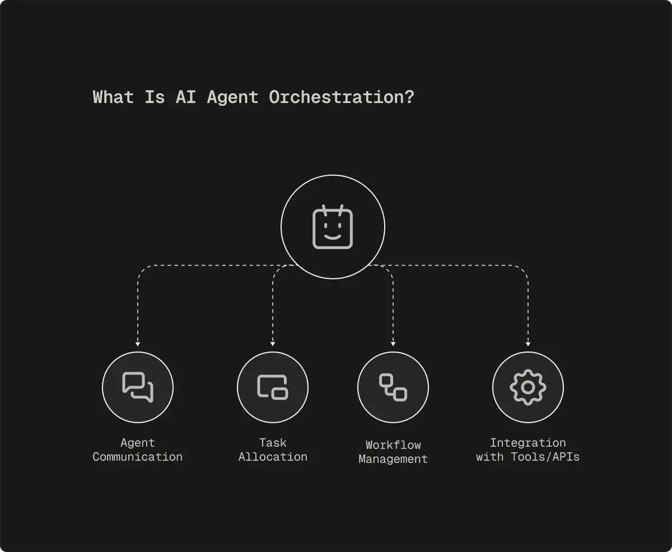
By coordinating how agents communicate, share information, and complete tasks, AI orchestration turns a group of independent agents into a cohesive system capable of handling complex workflows with greater accuracy and efficiency.
Types of AI Agent Orchestration
AI agent orchestration can be implemented in several ways, depending on the level of coordination, autonomy, and control you need. The table below breaks down four common orchestration models:
|
Orchestration Type |
Description |
Advantages |
Considerations |
|
Centralized |
A single orchestrator agent serves as the system's central coordinator, assigning tasks, managing workflows, and making final decisions on behalf of other agents. |
Consistent control and predictable workflows |
Can create a single point of failure |
|
Decentralized |
Agents coordinate directly with one another without relying on a central controller. Decisions are made independently or through group consensus. |
Highly scalable and resilient |
More complex coordination and governance |
|
Hierarchical |
Agents are organized in layers, with higher-level agents overseeing and coordinating lower-level agents. This structure resembles a tiered management model. |
Clear delegation and specialization |
Too much hierarchy can reduce flexibility |
|
Federated |
Independent agents, teams, or organizations collaborate while maintaining control of their own systems and data. Information is shared selectively rather than through a fully centralized platform. |
Supports collaboration while preserving data control |
Requires interoperability and trust between participants |
6 AI Agent Orchestration Best Practices
Below are six best practices for orchestrating reliable, scalable, and high-performing AI agent systems:
1. Define Clear Agent Roles and Handoffs
Without clearly defined responsibilities, agents can duplicate work, compete for the same tasks, or generate inconsistent outputs.
Here are some tips to improve agent coordination and workflow reliability:
- Assign specialized responsibilities – Give each agent a clear purpose and area of expertise. For example, one agent may handle research, and another validation. Specialized multi-agent systems have demonstrated up to 90% performance improvements on certain workloads.
- Establish explicit handoff rules – Define when and why an agent should pass work on to another agent. Clear handoff conditions prevent confusion, redundant processing, and workflow loops.
- Use structured data for communication – Exchange information between agents using predefined formats such as JSON schemas or structured objects rather than free-form text.
- Manage shared context carefully – Determine what information should be shared across agents and what should remain agent-specific. Providing too little context can lead to poor decisions, while providing too much can increase costs and impede performance.
- Separate planning from execution – Consider using one agent to create a plan and other agents to execute specific tasks. This approach improves transparency, simplifies debugging, and makes workflows easier to maintain.
- Design for failure and escalation – Define how the system should respond when an agent cannot complete a task, produces low-confidence results, or encounters an error. Workflows should include retries, fallback paths, or escalation to a human when necessary.
2. Manage Latency and Performance
Multi-agent workflows often depend on external APIs and large language models, both of which can introduce delays. As workflows become more complex, response times can increase significantly as multiple agents perform tasks and share information.
Here are some strategies for keeping latency under control and maintaining strong performance:
- Limit API calls – Set reasonable limits on the number of API requests an agent or workflow can make. This helps prevent unnecessary calls and keeps workflows from becoming slow or expensive.
- Use caching – Store frequently used data and previous results so agents don’t have to repeat the same requests or calculations.
- Choose the right model – Use larger models only when needed for complex tasks. For simpler tasks, smaller models are often faster and more cost-effective.
- Run tasks in parallel when possible – If multiple agents can work independently, let them run at the same time instead of waiting for each other to finish. Studies show that parallel multi-agent execution achieves up to 2.2× faster completion times.
- Test under load – Regularly test your system with realistic, high-traffic scenarios to identify performance issues before they affect users.
3. Establish Guardrails and Keep Humans in the Loop
Giving AI agents more autonomy can improve efficiency, but also introduce risks. Without clear boundaries, agents may access information they shouldn't, make poor decisions, or perform unintended actions. This can be especially problematic in regulated industries, such as healthcare, banking, and financial services.
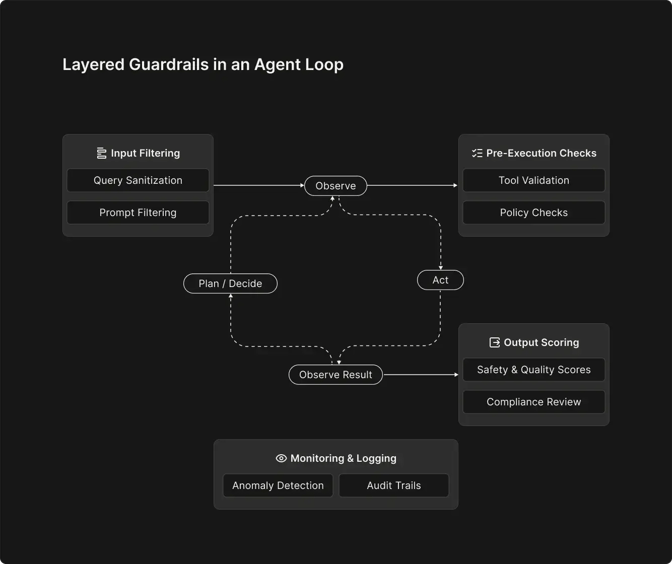
Here are some practical ways to build secure and reliable agentic systems:
- Limit access and permissions – Give each agent access only to the data, tools, and systems they need to perform their specific tasks.
- Encrypt communications and data – Use secure protocols such as Transport Layer Security (TLS) for all agent communications and protect sensitive data at rest. Consider end-to-end encryption for workflows involving highly confidential information.
- Anonymize and mask sensitive data – Remove or mask personally identifiable information (PII) and other sensitive data from prompts, context, and outputs unless it is strictly required for the task.
- Align with regulatory requirements – Design agent workflows to comply with applicable regulations such as GDPR, HIPAA, or the EU AI Act, including requirements for data retention, deletion, consent management, and auditability.
4. Choose the Right Framework
The framework you choose can significantly impact how easily you build, manage, and scale agentic workflows. Some focus on workflow orchestration and human oversight, while others are optimized for collaboration between multiple agents.
Here are some factors to consider when evaluating agent frameworks:
- Understand your use case – Start by defining what your agents need to do. Some frameworks are better suited for workflow automation, while others are designed for specialized agents that collaborate on complex tasks.
- Look for essential features – Prioritize frameworks that offer capabilities such as state management, memory, error handling, monitoring, and support for guardrails and human oversight.
- Ensure flexibility and interoperability – Choose tools that work with multiple models, APIs, and external systems so you can adapt as your needs evolve and avoid unnecessary vendor lock-in.
- Evaluate community and ecosystem support – Select frameworks with strong documentation, active communities, regular updates, and a rich integration ecosystem to reduce development effort and improve long-term maintainability.
- Plan for future growth – Consider how well the framework will support additional agents, more complex workflows, and higher workloads as your system scales.
5. Monitor Outputs and Guard Against Hallucinations
AI agents don't always produce reliable results. In fact, hallucinations are the #1 source of production AI bugs (82%), costing businesses $67.4 billion in 2024.
Here are some practical ways to improve output quality and reduce the risk of hallucinations:
- Log agent activity – Record the inputs, outputs, and key steps taken by each agent. This makes it easier to investigate issues and understand what happened when something goes wrong.
- Test real-world scenarios – Before deploying a new agent or workflow, run it through a variety of test cases, including edge cases and unusual situations, to identify where errors are most likely to occur.
- Evaluate outputs continuously – Regularly review and measure agent performance using automated evaluation tools to detect quality issues, unexpected behavior, or declining performance over time.
- Add validation checks – For important decisions or high-risk actions, require outputs to pass predefined checks or be reviewed by a human before they are used.
6. Establish Agent Evaluation Frameworks
To determine if AI agent orchestration was successful, you need a structured approach to measuring agent performance. Without clear evaluation criteria, it becomes difficult to identify performance issues, optimize workflows, justify costs, or demonstrate business value. Some of the most important metrics include:
|
Metric |
Measurement Focus |
|
Task Completion Rate |
How often agents successfully complete assigned tasks without failure or escalation |
|
Accuracy |
Whether agent outputs are correct, relevant, and aligned with the intended outcome |
|
Hallucination Frequency |
How often agents generate incorrect, fabricated, or unsupported information |
|
Response Time |
How quickly agents complete tasks and deliver results |
|
Cost Per Task |
Total cost of completing a workflow, including model usage, API calls, and infrastructure costs |
|
Human Intervention Rate |
How often humans need to review, correct, or override agent decisions |
Challenges of AI Agent Orchestration
Before implementing AI agent orchestration, it’s important to understand the key challenges that can impact performance, scalability, and long-term success:
- Integration with legacy systems – Many organizations still rely on older systems that are not designed to work seamlessly with AI agents. Connecting AI agents to these systems often requires custom integrations, which can increase costs and slow down implementation.
- Data quality and consistency – AI agents depend on accurate and well-structured data to perform effectively. If data is inconsistent, incomplete, or siloed, errors can quickly flow through automated workflows.
- Skill gaps and organizational readiness – Building and managing AI agent systems requires specialized skills that many organizations are still developing. Success also depends on teams being ready to adapt to new workflows.
- Security and privacy concerns – AI agents often handle sensitive information and interact with external applications. This creates additional security and compliance challenges that must be addressed from the start.
- Performance and reliability of agents – AI agents do not always behave consistently and can occasionally generate incorrect outputs. Ongoing testing, monitoring, and improvement are needed to ensure reliable performance in production environments.
- Cost and ROI pressures – The costs of AI models, infrastructure, and ongoing operations can add up quickly. At the same time, proving return on investment can be difficult if systems require frequent fixes or manual oversight.
Putting AI Agent Orchestration into Practice with Zenflow Work
Organizations adopting AI agent orchestration often struggle with the same challenges: coordinating multiple agents, maintaining governance and security, reducing hallucinations, integrating with existing systems, and scaling workflows across teams. Zencoder’s Zenflow Work helps with all of these aspects. It provides a unified orchestration platform that enables AI agents to collaborate effectively across both business and engineering workflows.
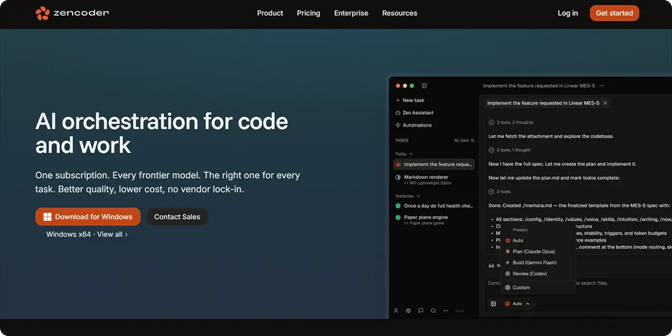
With Zenflow Work, users define the desired outcome, and AI agents determine the steps needed to achieve it. They gather the necessary context, complete tasks, monitor progress, and continue working until the goal is reached. Organizations are already using these workflows to automate repetitive multi-step processes across product and engineering, marketing, sales, operations, finance, and HR teams.
Key capabilities of Zenflow Work include:
- Goal-based execution – Agents plan, coordinate, and execute tasks until a defined objective is achieved.
- Multi-agent collaboration – Specialized agents can gather information, communicate updates, perform actions, and validate outputs across workflows.
- Cross-platform integration – It connects with tools teams already use, such as Jira, Linear, GitHub, Gmail, Google Calendar, Notion, Slack, HubSpot, and Google Docs.
- Workflow automation templates – Zenflow provides pre-built workflows for standups, release notes, customer feedback analysis, lead research, executive reporting, and ticket routing.
- Human-in-the-loop controls – Supports review, approval, and escalation workflows for high-impact decisions.
- File and document handling – Agents can work with PDFs, spreadsheets, presentations, and other business documents as part of larger workflows.
Zencoder includes enterprise-grade controls designed to help teams maintain visibility, accountability, and operational oversight at scale:
- Role-based access controls – Define who can create, modify, approve, and deploy workflows.
- Approval gates and audit trails – Built-in approval workflows and detailed audit trails provide full visibility into agent actions, decisions, and the execution history of workflows.
- Security and compliance support – Zenflow supports enterprise security and compliance requirements, including certifications such as SOC 2 Type II, ISO 27001, and ISO 42001.
- Data protection controls – Data protection policies help ensure that customer data is not used to train AI models, supporting privacy and regulatory requirements.
- Flexible deployment options – Organizations can deploy Zenflow in cloud, hybrid, or on-premises environments to meet their security, compliance, and operational requirements.
Start your free trial with Zencoder today and turn disconnected AI agents into coordinated workflows.

FAQ:
1. When should you use a multi-agent system instead of a single AI agent?
A single AI agent works well for simple tasks, but more complex workflows often require multiple agents working together. Multi-agent orchestration is the better choice when tasks involve different areas of expertise, parallel work, or coordination across multiple tools and systems.
2. What industries benefit most from AI agent orchestration?
AI agent orchestration delivers the greatest value in industries with large datasets and cross-functional processes. Common examples include healthcare, financial services, software development, customer support, and marketing.