Vibe coding and agentic coding are two AI-powered approaches to software development that help you build applications faster by shifting most of the code writing to AI.
The difference between vibe coding vs. agentic coding comes down to how much of the work the AI does on its own and how much of it you're expected to check. In this article, you'll learn how each one works, where it falls short, and when to use it.

Key Takeaways
- Vibe coding and agentic coding solve different problems
Vibe coding is best for turning ideas into working software as quickly as possible, while agentic coding is designed to complete complex development tasks with greater autonomy and reliability.
- A key difference is in how independently the AI works
Vibe coding relies on the back-and-forth between the user and the AI, whereas AI agents can plan, implement, test, debug, and iterate on their own until the objective is complete.
- Choose the approach based on your project's goals
Vibe coding is ideal for prototypes, experiments, and small personal projects where speed matters most. Agentic coding is a better fit for production code, larger repositories, and projects that require testing, security, and maintainability.
- Platforms like Zencoder help teams use both approaches effectively
Instead of choosing between conversational AI and autonomous agents, teams can get both with Zencoder. They can rapidly prototype ideas with natural language and then automate implementation, testing, and code reviews as projects move into production.
What Is Vibe Coding?
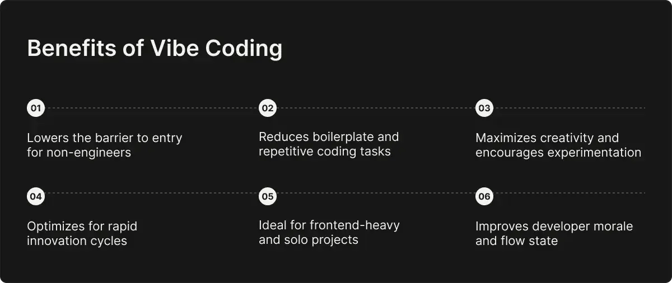
Vibe coding is a development approach where you describe what you want in natural language, and an AI tool generates most or all of the code for you. Instead of reviewing every implementation detail, you focus on whether the resulting application looks and behaves as expected. The goal is to turn ideas into working software quickly.
How Vibe Coding Works
A typical vibe coding workflow looks like this:
- The process usually starts with a simple request, such as, "Build a dashboard that lets freelancers track invoices, payments, and overdue clients."
- AI selects the technologies, generates the code, and produces a working version of the application based on the user's request.
- The user interacts with the application to see whether it looks and functions as expected, rather than reviewing every line of code.
- The user provides feedback in natural language, such as "Make the dashboard cleaner," "Add a dark mode," or "The invoice form isn't saving."
- AI modifies the implementation based on the feedback and regenerates the relevant parts of the application.
- If the application produces an error, the user can paste the error message into the conversation and ask the AI to resolve it.
- The user continues testing the application and providing feedback while the AI refines the code until the final result meets their expectations.
Worth knowing: To learn more about vibe coding, check out our article, “How to Get Started With Vibe Coding: The Definitive Guide”
What Is Agentic Coding?
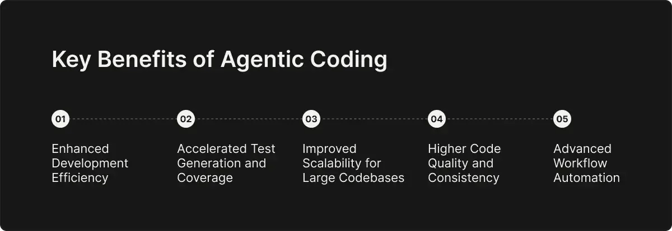
Agentic coding is a software development approach where an AI agent is given a goal and works through the steps needed to achieve it with minimal human input. Instead of stopping once code is generated, the agent can:
- Explore the codebase to understand how the project is structured
- Identify which files need to be created or modified
- Write, edit, and refactor code across multiple files
- Run commands, build the project, and execute tests
- Analyze errors, test failures, and other outputs
- Fix issues it discovers and verify that the changes work correctly
Rather than waiting for instructions after every step, the AI continuously evaluates its progress, decides what to do next, and repeats the process until the task is complete.
How Agentic Coding Works
A typical agentic coding workflow includes the following stages:
- The process starts with a high-level request, such as "Add passwordless authentication to the customer portal and update the related tests and documentation."
- AI reviews the project structure, identifies the relevant files, and maps how the existing code fits together before making any changes.
- AI breaks the overall objective into smaller tasks and determines the best approach for completing them.
- AI edits the necessary files, creates new ones when needed, and implements the required functionality across the project.
- AI runs the commands the task requires, such as installing approved dependencies, formatting code, or inspecting recent commits.
- AI runs tests, linters, type checks, and other validation tools to verify that the changes work as expected.
- When tests fail or errors occur, AI analyzes the results, updates the code, and repeats the process until the issue is resolved or additional user input is required.
- AI summarizes which files were changed, what decisions were made, which checks were completed, and whether any limitations remain.
- The user reviews the changes, confirms that the original goal has been achieved, and decides whether to accept or refine the implementation.
Vibe Coding vs. Agentic Coding: 5 Key Differences
At first glance, vibe coding and agentic coding may seem similar because they start from a natural-language prompt, but the five differences below show how far apart they actually are:
1. Core Purpose
Vibe coding primarily focuses on turning an idea into a usable result with as little friction as possible. The user doesn't need to decide exactly how to implement the feature. They describe the experience they want and continue prompting until the output seems right.
Agentic coding focuses on completing a specific software development task. While the instructions can still be written in natural language, they are typically more detailed and include clear requirements, technical constraints, and methods for verifying that the final result meets expectations.
2. Level of Autonomy
In vibe coding, the AI generates code, but the user stays closely involved throughout the process. The AI creates a version, the user tests it, provides feedback, and the cycle repeats until the result is satisfactory.
In agentic coding, the AI works much more independently. After receiving the objective, it can explore the codebase, decide what to change, run tests, fix issues it finds, and keep working with minimal human input.
3. Speed and Productivity
Vibe coding is usually the faster option when starting a new project. The user can go from a simple idea to a working prototype in minutes or hours. This makes it ideal for testing ideas or quickly building a proof of concept. As the project grows, however, progress can slow down. Repeatedly asking the AI to make small changes can lead to inconsistent code or unexpected bugs, especially if the user doesn't review how everything fits together.
Agentic coding requires setup because the AI works best with clear goals, requirements, and a well-structured codebase. However, once that groundwork exists, the agent can complete larger, more complex development tasks in a single workflow, reducing the manual coordination required of the developer.
4. Understanding and Visibility
Vibe coding lets the user build software without worrying much about how the code works. While this makes development more accessible, it could be problematic if something breaks. The user can ask the AI to fix it, but it's hard to tell whether the new change solved the problem or just buried it. In many cases, users have to rely on the AI to diagnose and resolve issues.
Agentic coding provides more visibility into the development process. The AI typically explains what it changed, why it made those changes, and how it verified that they worked, making it easier for developers to review and approve the results.
5. Security and Governance
With vibe coding, the focus is on speed, so AI-generated code may include placeholder credentials, overly broad permissions, weak authentication, or unverified third-party libraries. These shortcuts may be acceptable for a personal demo, but they can create serious security risks if the application is deployed or handles real customer data.
Agentic coding is better suited for production environments because the platforms built around it include security and governance controls. Organizations can limit what the AI can access, require approval before sensitive actions, automatically scan for vulnerabilities, and keep records of everything the agent does.
Vibe Coding vs. Agentic Coding: When to Choose Each Approach
Vibe coding and agentic coding aren't a permanent either/or choice. They are useful at different stages and for different levels of risk.
Choose vibe coding when:
- You want to test a product idea quickly
- You are building a disposable proof of concept
- The project will not process sensitive or regulated data
- You need an interactive mockup for a presentation
- You want to explore a new interface or user journey
- The cost of rebuilding the application is low
- You are creating a small personal tool with limited exposure
- Speed and experimentation matter more than long-term architecture
Choose agentic coding when:
- You are working inside an established repository
- The task affects multiple connected files
- You have defined acceptance criteria
- Automated tests and development checks are available
- The change must follow existing architectural conventions
- You need a documented and reviewable implementation
- The work involves bug fixes, migrations, refactoring, or maintenance
- A qualified developer will review the result before it is accepted
Bridging Vibe Coding and Agentic Coding with Zencoder
Vibe coding and agentic coding solve different problems, but many development teams use both throughout a project's lifecycle. For example, they might use conversational AI to quickly prototype an idea, then switch to a more autonomous workflow to implement, test, refactor, and maintain the production version.
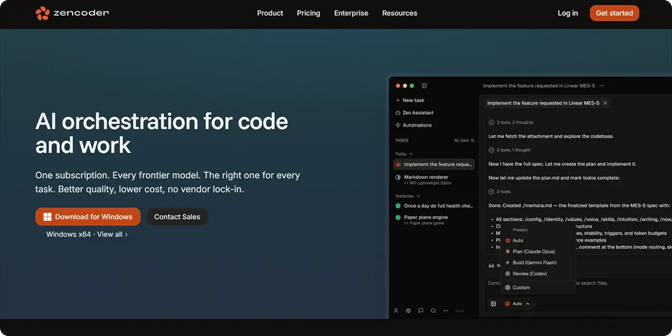
Zencoder combines conversational AI with agentic workflows to support the entire development lifecycle.
Some of its key features include:
1. AI Coding Assistant – Zencoder's AI Coding Assistant helps developers write code faster and with greater confidence. It generates production-ready code, provides context-aware code completion, and answers coding questions through an integrated AI chat. It also automatically reviews code to identify bugs, security issues, and opportunities to improve code quality before changes are merged.
2. Zenflow Code – Zenflow Code orchestrates multiple AI agents into a structured development workflow that runs from planning through deployment. Rather than functioning as a simple coding assistant, it manages the entire software lifecycle, from planning to deployment.
With Zenflow Code, you can:
- Build with spec-driven workflows – Define features, bug fixes, or refactors using specs, PRDs, or architecture docs. Agents follow these precisely, keeping code aligned with requirements and preventing “AI drift.”
- Run multi-agent execution – Coordinate specialized AI agents for building, testing, reviewing, and refactoring code across your entire stack.
- Automate engineering workflows – Schedule recurring tasks like PR reviews, bug triage, or backlog updates, and let Zenflow handle them continuously in the background.
- Execute tasks in parallel – Run multiple coding tasks simultaneously in isolated environments, accelerating development without impacting your main codebase.
- Scale across teams and repositories – Maintain consistency across multiple repos, with agents understanding dependencies to prevent breaking changes.
- Integrate your toolchain – Connect with GitHub, Jira, CI/CD systems, and 100+ other tools to give agents a full context of your development environment.
3. Repo Grokking™ – Repo Grokking analyzes your entire codebase to understand how your application is structured, how different components work together, and which coding patterns your team follows. By giving AI agents a deeper understanding of your project, it helps them generate more accurate code, make safer changes, and maintain consistency across repositories.
4. Zen Agents – Zen Agents let you create AI assistants for specific development tasks, such as reviewing pull requests, writing documentation, testing code, or refactoring applications. They integrate with tools like GitHub and Jira, can be shared across your team, and can either be built from scratch or selected from a library of ready-to-use agents.
5. Zenflow Work – Zenflow Work is a team-wide AI assistant platform. Its agents take a goal, plan the required steps, and work across your tools until the task is complete.
With Zenflow Work, you can:
- Define outcomes, not tasks – Simply describe what "done" looks like, and the agents will plan, execute, and iterate until the goal is achieved.
- Automate multi-step workflows – The agents can automate complex, ongoing workflows, from standups and meeting preparation to follow-ups and reporting, across multiple tools.
- Work across your entire tech stack – The platform integrates with tools like Jira, Linear, GitHub, Gmail, Slack, and Google Docs, allowing agents to read, write, and take action where work happens.
- Get started quickly with templates – Use pre-built workflows, such as standup summaries, lead research briefs, or dependency audits, and customize them to fit your team's needs.
- Continuously monitor and adapt – The agents monitor emails, product data, social platforms, and internal tools in real time, updating documents, reports, and dashboards as information changes.
- Automate communication loops – The agents automatically send follow-ups, track responses, and escalate conversations when needed.
- Manage tasks end-to-end – The agents can pick up work from tickets, messages, or files, complete the required tasks, and deliver results with minimal manual coordination.
Start with Zencoder today and use conversational AI and autonomous agents to accelerate every stage of the software development lifecycle.

FAQ:
1. Does agentic coding replace software developers?
No. Agentic coding automates many development tasks, but developers are still needed to define requirements, review changes, make architectural decisions, and ensure the software meets business and security requirements. The goal is to increase developer productivity, not eliminate human oversight.
2. What skills do you need to get started with vibe coding or agentic coding?
Vibe coding is generally more accessible to beginners because it relies on natural language prompts rather than deep programming knowledge. To use agentic coding effectively, you should understand software development concepts such as code structure, testing, version control, and system architecture.
3. What are the risks of vibe coding?
Vibe coding can introduce security vulnerabilities, inconsistent code, unnecessary dependencies, and maintainability problems when AI-generated code is accepted without sufficient review.
4. Can you turn a vibe-coded prototype into production software?
Yes, but a working prototype usually needs additional engineering before it is ready for production. Developers may need to review or refactor the generated code, add automated tests, strengthen security, improve the architecture, and validate that the application can be maintained and scaled.
5. How much human oversight does agentic coding require?
Agentic coding requires less day-to-day input than traditional AI-assisted coding, but developers still need to set clear requirements and review the final changes. Human oversight is especially important for production code, where mistakes can affect security, performance, and other parts of the application.