Agentic AI and traditional automation are technologies that help organizations automate tasks, streamline workflows, and enhance productivity across a wide range of operations.
If you're looking to improve efficiency or unlock new opportunities for innovation, understanding the differences between these approaches can help you identify the best fit for your business. In this article, we’ll explore agentic AI vs. traditional automation, including their capabilities, decision-making approaches, and practical applications.

Key Takeaways
- Agentic AI goes beyond task execution to achieve goals
Traditional automation follows predefined rules, while agentic AI can understand objectives, create plans, make decisions, adapt to changing conditions, and execute multi-step workflows with minimal human intervention.
- The right choice depends on the complexity of the work
Traditional automation is ideal for repetitive, predictable processes such as data entry, reporting, and compliance tasks. Agentic AI is better suited for dynamic workflows involving unstructured data, decision-making, research, and exception handling.
- A hybrid approach delivers the best business outcomes
Most organizations do not need to choose one or the other. When combined, agentic AI and automation can significantly improve efficiency, accuracy, and scalability.
- Governance and oversight remain essential
Agentic AI provides flexibility and autonomy, but it also introduces the possibility of unexpected outputs. Organizations should establish guardrails, monitoring, approval workflows, and human review processes to ensure reliable and compliant operations.
- Platforms like Zenflow Work help you operationalize Agentic AI
Zenflow Work combines workflow automation with autonomous AI agents to streamline workflows end-to-end. With pre-built templates and multi-system orchestration, organizations can quickly deploy AI-powered processes across business operations.
What Is Agentic AI?
Agentic AI refers to AI systems that can operate autonomously, perceive their environment, reason about goals, and take action on behalf of users. Unlike traditional AI tools, agentic systems can independently manage tasks from planning through execution rather than just responding to individual prompts.
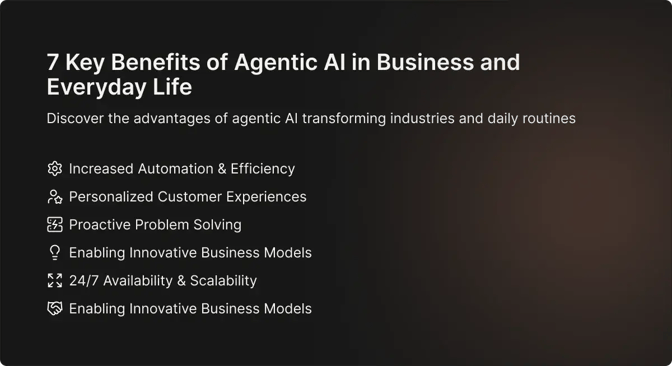
They can also coordinate with software, external tools, and other AI agents, which allows them to complete complex workflows with little to no human intervention.
How Does Agentic AI Work?
Agentic AI relies on five core capabilities that enable it to achieve goals autonomously. Here’s how it works:
- Perception – The agent gathers information from sources such as databases, documents, sensors, and APIs to understand its environment and establish context. It identifies relevant entities, extracts key information, and interprets objectives.
- Reasoning – Using large language models (LLMs) and other AI systems, the agent analyzes objectives, breaks them down into manageable tasks, and develops an execution plan. It can adapt its approach when conditions change, new information becomes available, or a tool fails.
- Action – The agent executes tasks by interacting with software applications, APIs, automation workflows, bots, and cloud services. It performs actions within predefined operational and security boundaries to achieve the desired outcome.
- Learning – The agent captures outcomes, feedback, and historical context to improve future performance. By refining rules, updating models, and retaining memory, it becomes increasingly effective and context-aware over time.
- Coordination – In multi-agent environments, specialized agents can collaborate to achieve broader objectives. A supervisory or orchestration agent manages priorities, resolves conflicts, and coordinates activities to ensure efficient collaboration.
What Is Traditional Automation?
Traditional automation refers to rule-based technologies such as macros, scripts, workflow engines, and robotic process automation (RPA), which perform repetitive tasks by following predefined instructions. These systems can replicate routine user actions, including data entry, file transfers, transaction processing, reconciliation, and spreadsheet updates.
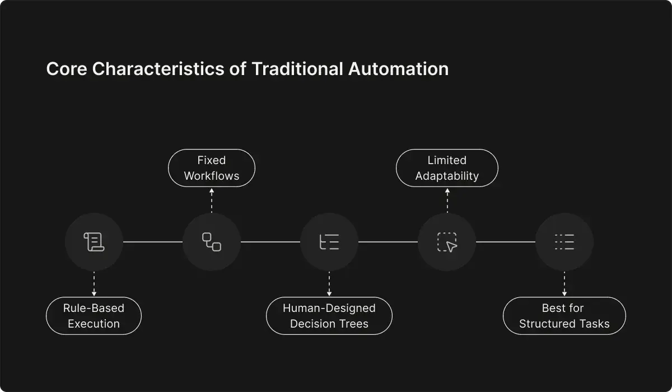
Traditional automation is often the first step in an organization’s automation journey before adopting more advanced technologies such as intelligent automation and AI-driven systems.
How Does Traditional Automation Work?
Traditional automation relies on a structured workflow that guides execution from start to finish:
- Capturing or defining user actions – A developer records a sequence of steps or creates a script that specifies how a task should be performed, such as opening an application, copying information, and entering it into another system.
- Executing deterministic workflows – Once deployed, the automation follows the sequence of actions exactly as designed, performing the same task consistently each time it’s triggered.
- Interacting with systems and applications – During execution, the system enters data, clicks buttons, navigates screens, and calls APIs across one or more applications, just as a human user would.
- Processing structured data and predefined inputs – Information is handled according to established rules and logic, making traditional automation most effective in environments with predictable data formats and stable processes.
- Recording execution activities and outcomes – Detailed logs are generated throughout the workflow. These provide visibility into completed actions and support monitoring, compliance, and audit requirements.
Agentic AI vs. Traditional Automation: Detailed Comparison
While both agentic AI and traditional automation help organizations increase productivity, they operate in different ways. The table below highlights the key distinctions:
|
Category |
Agentic AI |
Traditional Automation |
|
Autonomy & decision- making |
|
|
|
Human involvement & oversight |
Requires humans to set goals, define guardrails, and monitor outcomes, but can operate with minimal day-to-day supervision |
Often requires human intervention for exceptions, maintenance, and updates when processes or business rules change |
|
Task complexity & data handling |
Suited to complex workflows and capable of working with both structured and unstructured data, including documents, emails, images, and databases |
Primarily works with structured data such as spreadsheets, databases, and standardized forms with consistent inputs and outputs |
|
Implementation, scalability & value |
|
|
|
Risk & reliability |
More flexible but can produce unpredictable outputs or errors, so governance and monitoring are crucial |
Highly predictable and auditable because actions follow defined rules, although mistakes can occur if the underlying rules are incorrect |
Agentic AI vs. Traditional Automation: When to Use Each Approach
Choosing the right approach for your organization depends on the nature and complexity of the task you are trying to solve. The examples below will help you identify when traditional automation, agentic AI, or a hybrid approach is likely to deliver the best results.
When to Use Traditional Automation
Use traditional automation for:
- Data entry and migration – Processing invoices, managing payroll, generating reports, and transferring data where formats and business rules remain consistent
- Spreadsheet management and reconciliation – Matching transactions, reconciling accounts, maintaining spreadsheets, and producing standardized reports
- Legacy system integration – Transferring data and automating processes across older systems that lack modern APIs or integration capabilities
- Compliance and regulatory reporting – Generating reports, maintaining audit trails, and ensuring accurate record-keeping for regulatory requirements
- Front-office support – Handling routine customer service requests such as password resets, account lookups, and appointment scheduling
- Manufacturing and operations management – Tracking inventory, creating purchase orders, and updating production schedules as part of routine operations
- Billing and revenue operations – Generating invoices, sending payment reminders, applying account restrictions, and producing billing reports
When to Use Agentic AI
Use agentic AI for:
- Intelligent document processing – Extracting information from contracts, financial statements, onboarding forms, and other unstructured documents, while validating content against business rules and identifying anomalies
- Customer service and support – Managing customer interactions, understanding intent, generating personalized responses, and escalating complex cases when needed
- End-to-end workflow orchestration – Coordinating activities across multiple systems, applications, and teams to automate complex business processes from start to finish
- Fraud detection and risk assessment – Analyzing transactions and behavioral signals in real time to identify suspicious activity and make risk-based decisions
- Sales follow-up and deal management – Researching prospects, personalizing outreach, prioritizing opportunities, and managing follow-up activities throughout the sales cycle
- Hiring and candidate screening – Sourcing candidates, screening resumes, conducting initial interactions, scheduling interviews, and supporting recruitment workflows
- Lead generation and outreach – Identifying prospects with the best AI lead generation tools, performing research, using tools to collect email addresses, executing personalized outreach campaigns, and managing ongoing engagement at scale
Agentic AI vs. Traditional Automation: Hybrid Approach
Organizations often achieve the best outcomes by combining rule-based automation and agentic AI, applying each technology to the tasks it handles most effectively. Key principles for a hybrid approach include:
- Start with rule-based automation to standardize processes – Use scripts or bots to automate repetitive workflow tasks, creating predictable boundaries and clear handoff points.
- Layer in AI agents for more complex steps – Once the core process is streamlined, introduce agentic AI to interpret unstructured inputs, manage exceptions, and make decisions. Agents complement rule-based automation by adding reasoning, contextual awareness, and cross-functional coordination.
- Identify high-value integration points – Focus on processes where rule-based automation already delivers value but still requires human judgment or handling of unstructured data. These gaps are often ideal opportunities for AI agents.
- Ensure human oversight and guardrails – Even in hybrid systems, humans should monitor outputs, review decisions, and handle low-confidence cases.
In the table below, you can find some examples of hybrid automation:
|
Use Case |
Rule-Based Automation Role |
Agentic AI Role |
Outcome |
|
Invoice processing |
Processes high-volume, standardized invoices |
Analyzes unstructured documents, extracts key data, and handles exceptions by approving, rejecting, or requesting additional information |
Faster invoice processing, even when issues or exceptions arise |
|
Customer onboarding |
Handles standard data entry and validation for onboarding forms |
Verifies documents, cross-references information across multiple files, and flags discrepancies |
Faster onboarding with improved compliance and accuracy |
|
IT operations |
Automatically resolves routine IT issues using predefined scripts |
Analyzes incidents, identifies their severity, and decides if escalation is needed |
Accelerated response times while maintaining operational reliability |
|
Sales and HR processes |
Performs administrative tasks such as updating CRM records and scheduling interviews |
Analyzes customer or candidate conversations, generates insights, and prioritizes follow-up actions |
More consistent follow-ups and higher-quality sales and hiring decisions |
|
Document- heavy workflows |
Enters results into systems of record and sends notifications |
Extracts, interprets, and analyzes information from legal contracts, financial statements, and other complex documents |
End-to-end automation with enhanced speed and accuracy |
Bringing Agentic AI to Life with Zenflow Work
As organizations adopt hybrid automation strategies, they need platforms capable of orchestrating both structured workflows and autonomous AI-driven processes. This is where platforms like Zencoder’s Zenflow Work can help.
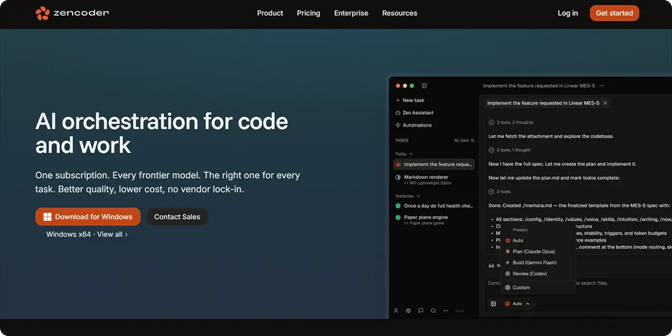
Unlike traditional automation tools that require predefined rules for every scenario, Zenflow agents can monitor information across multiple systems, adapt to changing conditions, coordinate activities, and manage multi-step workflows with minimal human intervention. Zenflow Work integrates with a wide range of business applications. That includes Jira, GitHub, Linear, Gmail, Google Calendar, Slack, Notion, HubSpot, Amplitude, Datadog, and many other tools commonly used across modern enterprises.
Organizations are already using Zenflow Work to automate complex business processes, such as:
- Product and engineering operations – Generating standup summaries, triaging bugs, creating release notes, monitoring software dependencies, and coordinating feature delivery across development tools
- Sales and business development – Researching prospects, creating meeting preparation briefs, enriching inbound leads, automating follow-up sequences, and routing opportunities to the appropriate teams
- Finance and accounting – Tracking invoices, matching receipts to expenses, identifying budget variances, compiling audit-ready documentation, monitoring spending patterns, and generating financial reports for stakeholders
- Executive reporting and operations – Compiling dashboards, aggregating data from multiple business systems, generating reports, and providing leadership teams with actionable insights
- Customer support and success – Identifying recurring customer issues, converting support requests into engineering tasks, tracking customer feedback, and coordinating resolution workflows
- Marketing and growth – Monitoring product launches, tracking customer sentiment, gathering competitive intelligence, and producing performance summaries
Zenflow Work also includes a growing marketplace of pre-built automation templates. Rather than building a workflow from scratch, teams can select a template, customize the goal, connect the required tools, and deploy the automation in minutes. Some of the available templates include:
|
Template |
Description |
|
Jira standup brief |
Automatically search Jira for updates and generate a concise five-bullet standup summary every morning. |
|
Customer request to shipped feature |
Take a feature request from a Linear ticket and coordinate the end-to-end implementation workflow across development systems. |
|
Lead research brief |
Before every sales call, research the prospect and automatically create a one-page briefing document. |
|
Follow-up loop until meeting booked |
Automatically send personalized follow-up emails until a prospect responds or a meeting is scheduled. |
|
Daily executive dashboard |
Compile daily executive summaries from multiple business systems into a single executive report. |
|
Customer voice to Jira ticket |
Analyze support tickets for recurring customer themes and automatically create engineering issues backed by customer evidence. |
|
Support ticket to engineering issue |
Route high-priority support requests directly into engineering workflows. |
|
Security & dependency audit |
Regularly scan repositories for outdated dependencies and known vulnerabilities, then propose safe upgrade paths. |
|
Inbound lead enrichment & routing |
Enrich inbound leads with company intelligence and automatically route high-priority opportunities to the appropriate sales representative. |
Start your free trial today and transform manual, multi-step processes into intelligent workflows powered by autonomous AI agents.

FAQ:
1. Can agentic AI replace traditional automation?
No, agentic AI is not a complete replacement for traditional automation. Organizations typically use both technologies together, using each where it delivers the most value.
2. What are the biggest challenges of implementing agentic AI?
Implementing agentic AI requires careful attention to governance, security, and accuracy. Organizations must establish guardrails, monitoring processes, and access controls to ensure AI agents operate safely and reliably.
3. How do you measure the ROI of agentic AI?
The ROI of agentic AI can be measured through time savings, reduced operational costs, improved productivity, and fewer manual tasks. Organizations may also see additional value from faster decision-making, better customer experiences, and increased process scalability.