Did you know that 62% of developers rely on at least one AI assistant in their workflow? What began as a simple autocomplete feature has evolved into powerful tools that shape how code is written, reviewed, tested, and optimized. While the current state of software engineering was hard to imagine just a few years ago, the future looks even more promising. In this article, we’ll explore the future of software engineering with AI and how you can prepare for it.

Key Takeaways
- AI is already reshaping day-to-day software development
AI tools are no longer experimental. They actively write code, generate tests, review pull requests, assist with DevOps, and produce documentation. For many teams, AI now handles a meaningful share of routine engineering work, freeing developers to focus on higher-impact decisions.
- The future points toward autonomous, end-to-end development workflows
AI is evolving from autocomplete to agent-based systems that can plan tasks, generate full features, test them, and manage deployments. Over time, engineers will describe what they want built, while AI systems will handle much of the execution across the entire SDLC.
- Human engineers will move up the stack, not disappear
As AI takes on boilerplate work, developers will increasingly act as architects and strategists. Their value will come from defining requirements, making design tradeoffs, ensuring security and compliance, and aligning technical decisions with real business and user needs.
- Strong governance and review processes are non-negotiable
AI-generated code can introduce hidden bugs, security risks, licensing issues, and long-term technical debt. Teams must treat AI output like human code by enforcing reviews, security checks, documentation standards, and clear accountability to avoid costly downstream problems.
- The right AI platform determines whether teams gain leverage or chaos
To truly benefit from AI, teams need tools that understand the full codebase, coordinate multiple agents, and verify work before it ships. Zencoder is built for this future, combining autonomous agents, full-repo intelligence, testing, and deep integrations to help teams ship faster with confidence, not guesswork.
What Is AI Capable of Doing in Software Engineering?
AI tools today function like advanced assistants in the coding workflow, and their impact is becoming increasingly significant. Across the industry, they are no longer experimental add-ons but everyday tools that shape how software is built. Estimates suggest that around 30% of new code at companies like Google and Microsoft is now generated by AI. Supporting this trend, a Stack Overflow survey found that 82% of developers who use AI tools rely on them primarily for writing code.

Below are some of the key tasks that AI assistants can handle:
- Code completion and generation – Modern AI assistants, such as Zencoder or GitHub Copilot, can suggest entire code snippets or functions based on the surrounding context and comments. They translate natural-language instructions into working code and can even help refactor or migrate existing code.
- Automated testing – AI tools can automatically generate unit and integration tests for codebases. Some tools generate test cases for every function and edge case, greatly reducing the manual effort required to write and maintain tests.
- Intelligent code review and fixes – AI tools can scan code for bugs, style issues, and security vulnerabilities before it reaches production. AI-powered linters and review bots can flag problems and often suggest fixes, helping developers catch weak dependencies, outdated libraries, or missing error handling.
- DevOps and deployment assistance – AI supports deployment by helping teams plan releases and monitor systems in real time. It can assess release risk, recommend rollout strategies, and automatically detect issues or trigger rollbacks if problems arise. When integrated into CI/CD pipelines, AI can also run targeted tests or analyze logs to catch security or performance issues before code is merged.
- Documentation and knowledge queries – AI assistants can answer developer questions about a codebase and generate helpful documentation on demand. They can create code comments, draft documentation from user stories, summarize code behavior, and even translate between languages or frameworks.
- Project planning and requirements – AI tools can analyze user stories, support tickets, and usage data to suggest feature ideas or draft initial specifications. Some tools also help organize backlogs, estimate effort, and recommend priorities based on past sprint data, helping teams align on what to build before coding begins.
The Future of Software Engineering with AI
Looking ahead, experts predict a future where AI participates in every phase of development and even collaborates as a virtual team member. Here are several key forecasts for how AI will reshape engineering:
1. Autonomous AI Developer Agents
We’re moving toward a new generation of AI agents that can handle software development from start to finish. Some tools already demonstrate this shift by planning tasks, writing code, and executing full development workflows with little human input.

In the future, development may be handled by teams of specialized AI agents working together: one focused on system architecture, another on implementing features, and another on testing and quality assurance, with each developer also supported by a personal AI agent that aligns with their workflow and enhances coordination across the entire system.
Ultimately, this points to a future where a user can simply describe a product idea, and an AI system can independently build a complete, working application, from backend to frontend, with minimal human oversight.
2. Automated End-to-End Workflows
Automation is expanding across every stage of the software development lifecycle (SDLC). AI systems can:
- Interpret requirements and analytics
- Draft technical specifications
- Generate code and tests from high-level descriptions
- Manage deployments by assessing risks and selecting appropriate release strategies
In practice, this could mean a developer simply describes a feature, such as “create a user login API with two-factor authentication”, and the AI generates the necessary code, configures deployment pipelines, and sets up monitoring dashboards automatically.
3. New Engineer Roles: Architects and Strategists
As AI automates and accelerates many boilerplate and repetitive coding tasks, human developers will naturally shift up the stack. The next generation of software engineers will spend less time writing code line by line and more time focusing on system architecture.
Instead of manually implementing every API function, engineers will decide which APIs are needed, how components should interact, and where AI-generated solutions are sufficient vs. where custom innovation is required. Their role will be to ensure that AI-generated code aligns with business objectives, security standards, and real user needs, bringing strategic oversight to an increasingly automated development process.
4. IDEs Adapted for AI Developers
As AI becomes an active member of development teams, human developers will need new tools to effectively manage these digital teammates. That includes assigning tasks, tracking progress, and reviewing AI-generated work, directly within the IDE.
Future IDEs will feature intuitive, manager-style interfaces that show what each AI agent is working on, surface task queues and statuses, and make it easy to answer questions or provide feedback. As AI takes on more responsibility for updates and ongoing maintenance, these coordination tools will become essential.
5. AI Assistants as Technical Leads
AI assistants are on track to evolve beyond coding helpers into project-level advisors. In time, they could function much like technical leads, able to answer architectural questions, explain design decisions, and provide guidance across the entire system.
Today’s large language models can already respond to general development questions and analyze specific pieces of code, but their understanding is typically limited to the context explicitly provided in a prompt.
As these systems mature, that constraint will fade. Future AI assistants will draw insight from the:
- Full codebase
- Version history
- Issue trackers
- Team discussions
- Project documentation
With this broader awareness, they’ll be able to offer informed recommendations, identify inconsistencies, and provide strategic technical direction grounded in the project’s complete context.
Limitations to Be Aware Of
AI’s rapid advance is exciting, but teams must remain mindful of its limitations. AI-generated code and suggestions are not flawless, and blind reliance can create hidden problems. Here are some factors to keep in mind:
- Accuracy and quality issues – AI can produce answers that look correct but contain hidden mistakes, logical flaws, or inefficient code. Always review its output carefully and test thoroughly, especially in high-performance or safety-critical systems where small errors can have serious consequences.
- Security and vulnerabilities – AI-generated code can unintentionally introduce security risks, including outdated libraries, unsafe patterns, or accidental exposure of sensitive data. To prevent leaks or vulnerabilities, organizations should sanitize inputs, limit data sharing, and require strict security reviews for any AI-assisted changes.
- Intellectual property (IP) and licensing risks – Because AI models learn from public code, they may generate outputs that resemble copyrighted or licensed material. Developers should treat AI suggestions as inspiration, not ready-to-ship code, and verify license compliance before using anything substantial.
- Technical debt and maintainability – Relying too heavily on AI can create code that teams don’t fully understand, leading to long-term maintenance problems. Engineers should be able to explain, document, and confidently modify any AI-generated code before it is incorporated into the codebase.
- Skill erosion – Overdependence on AI tools can weaken developers’ critical thinking, debugging, and problem-solving skills. Teams should use AI as a support tool while continuing to build strong fundamentals, ensuring they can work effectively even without automation.
- Context and creativity gaps – AI performs best on clearly defined tasks but struggles with ambiguity, innovation, and deep domain understanding. For complex or novel problems, human judgment and creativity remain essential.
- Regulatory and ethical constraints – As AI adoption grows, organizations must comply with emerging regulations and ensure transparency around AI-generated work. Teams should establish governance practices that address accountability, fairness, security, and proper documentation.
How to Prepare Your Team for an AI-Driven Future
Here are some practical strategies and key considerations to help you get the greatest value from AI tools, integrate them effectively into your team’s processes, and prepare for the future of software engineering:
1. Invest in Training and Culture
Encourage engineers to build both foundational skills and hands-on experience with AI tools, and frame AI adoption as a learning journey. For example, the team at Faire chose to develop their AI tool in-house so engineers could work directly with the technology, noting that gaining these skills was “an important part of the overall culture shift.”
Regular workshops, knowledge-sharing sessions, and internal AI hackathons can further reinforce this mindset, helping teams feel confident in the technology.
2. Maintain Rigorous Review Processes
Treat AI-generated code the same way you treat human-written code. Developers should never merge AI suggestions without fully understanding them, and reviewers should expect contributors to explain AI-assisted code as if they authored it themselves. To support this, teams should:
- Require developers to explain any AI-generated code during reviews
- Pair junior engineers with senior engineers on AI-assisted tasks for guidance and oversight
- Apply the same coding standards, guidelines, and linting rules to all code, regardless of whether it was written by AI or a human
- Automate checks for security vulnerabilities, style issues, and license compliance in AI-generated code
3. Track and Manage AI Technical Debt
Monitor how AI-assisted development impacts your codebase over time. Use clear metrics to determine whether AI-generated code introduces hidden costs or additional maintenance work. For example, track whether the “time to fix bugs” is higher in AI-written code or whether engineers are spending disproportionate effort debugging AI outputs instead of building new features.
4. Stay Informed on Regulations and Ethics
As AI regulations and standards continue to evolve, teams need clear ownership and proactive oversight. Designate a person or small group to monitor relevant frameworks, such as the GDPR, the EU AI Act, and NIST guidelines, and assess their impact on your software and development practices. This group should translate regulatory requirements into practical internal policies. For example, teams should:
- Prohibit sending proprietary or sensitive code to public AI services
- Require anonymizing or minimizing sensitive data included in prompts
- Document when AI tools are used in developing critical or high-risk code
- Maintain logs of AI usage to support transparency and future audits
Step Into the Future of Software Engineering with Zencoder
As AI becomes a permanent part of modern software development, choosing the right tools is just as important as adopting the right mindset. While many AI assistants focus narrowly on code completion, Zencoder is designed to support developers across the entire engineering workflow.
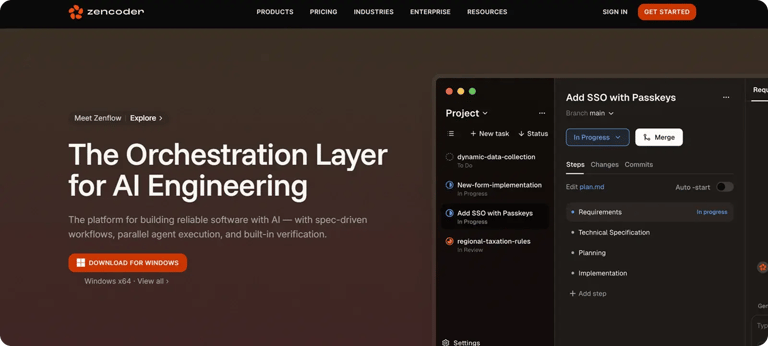
Zencoder is an advanced AI coding agent that elevates your software development lifecycle (SDLC) by enhancing productivity, accuracy, and innovation. Leveraging its powerful Repo Grokking™ technology, Zencoder analyzes your entire codebase, identifying structural patterns, architectural logic, and custom implementations.
Key Features:
- Zenflow – Zenflow is an AI-first engineering orchestration layer that coordinates multiple specialized agents to plan, build, test, review, and ship software from specs, not guesses. It enables parallel, self-verifying workflows where code is automatically tested and fixed before reaching developers, keeping delivery fast and reliable.
- Zentester – Zentester is an autonomous AI testing system that generates, runs, and maintains tests across the full stack using plain-English instructions. It continuously adapts to code changes, identifies risky paths and edge cases, and ensures high coverage without manual test maintenance.
- Zen Agents – Zen Agents are customizable AI teammates that understand your codebase, tools, and workflows, and can be deployed instantly across an organization. They handle specialized tasks such as reviews, refactoring, and integrations, consistently scaling expert knowledge across teams.
- Integrations – Zencoder offers deep integrations with over 20 developer tools, allowing AI agents to operate directly inside your existing IDEs, repositories, and CI/CD pipelines. This gives AI full lifecycle awareness, eliminating context switching and enabling truly end-to-end automation.
- AI Coding Assistant – The AI Coding Assistant accelerates development with context-aware code completion, production-ready code generation, and continuous AI-driven code reviews. It works alongside developers in real time, improving quality, security, and consistency without interrupting flow.
- Multi-Repo Search – Multi-Repo Search enables AI agents to index, understand, and reason across complex multi-repository architectures. This allows agents to make informed changes, trace dependencies, and answer questions using system-wide context instead of isolated code fragments.
Start with Zencoder today and step confidently into the future of software development!