Robotic Process Automation (RPA) and AI agents are two powerful technologies that help businesses automate workflows, streamline operations, and reduce repetitive manual tasks.
Although both are designed to automate tasks and streamline operations, they operate in very different ways. RPA follows predefined rules, while AI agents can learn, adapt, and make decisions based on data and context. In this article, we’ll explore RPA vs. AI agents, their key differences, and how to determine which solution is best suited for your business needs.

Key Takeaways
- RPA is best for repetitive, rule-based tasks
RPA works well when processes are predictable and structured, like moving data between systems, generating reports, or handling invoices. It’s fast to deploy and delivers quick efficiency gains, but it struggles when workflows change or require judgment.
- AI agents are built for adaptability and decision-making
Unlike RPA bots that follow fixed scripts, AI agents can reason through tasks, interpret unstructured data, and adjust their actions based on context. This makes them ideal for workflows involving emails, documents, research, troubleshooting, and customer support.
- The biggest differences are flexibility and predictability
RPA offers consistency, auditability, and reliable execution in regulated environments. AI agents provide more autonomy and can solve more complex problems, but they require stronger oversight, governance, and monitoring.
- Many businesses benefit most from combining both technologies
RPA and AI agents work best together. RPA can handle repetitive backend workflows, while AI agents handle reasoning-heavy tasks such as analyzing information, prioritizing requests, and recommending actions.
- Zencoder helps engineering teams move beyond basic automation
Instead of relying on isolated automation tools, Zencoder combines autonomous AI agents, repository-wide intelligence, and automated testing into one platform that helps teams ship software faster and more reliably.
What Is RPA?
Robotic Process Automation (RPA), also known as software robotics, uses intelligent automation technology to perform repetitive, rule-based processes with minimal human involvement. It works by combining APIs and user interface (UI) interactions to connect different business and productivity applications, allowing tasks to be completed automatically across multiple systems.

Using rule-based software and scripts that mimic human actions, RPA can handle high-volume business activities with greater speed and accuracy. This helps organizations save time and allows employees to focus on more strategic and complex work.
What Are AI Agents?
AI agents are autonomous software systems that combine large language models (LLMs) with planning, memory, and tool-use capabilities to complete tasks independently. Unlike a standard chatbot that simply responds to prompts, AI agents can break goals into steps, choose tools such as web searches or APIs, evaluate results, and adjust their actions as conditions change.

They are trained on data rather than programmed with fixed rules, allowing them to interpret unstructured information such as emails, documents, and images and make more adaptive decisions.
RPA vs. AI Agents: Key Differences
Below are key distinctions between the two technologies across six core categories.
1. Autonomy and Decision-Making
RPA bots work like macros. Once a sequence of clicks and keystrokes is recorded or programmed, the bot repeats the same steps every time. Their logic is limited to predefined rules and basic conditions, so they cannot adapt when something unexpected happens. If a website changes layout or requires a new input, the bot typically fails until a developer updates the workflow.
AI agents take the opposite approach. Rather than following a fixed script, they plan actions at run time, deciding which tool to use, evaluating results, and determining the next step. Agents can reason about goals, break them into tasks, and adapt based on feedback. This makes them more flexible and resilient to change, but also less predictable and in need of closer monitoring.
2. Data Handling and Input Complexity
RPA works best with structured data from predictable sources. Bots can open emails, copy values into databases, extract fields from invoices, and format spreadsheets. However, they struggle with unstructured data such as images, videos, or natural language. If the input format changes or the data becomes inconsistent, the bot often fails to complete the task.
AI agents are designed to handle unstructured and semi-structured data more effectively. Using technologies such as large language models, natural language processing, and computer vision, they can interpret text, recognize patterns in images, and extract meaning from messy or inconsistent data. This allows them to:
- Categorize customer emails
- Prioritize support tickets
- Draft personalized responses
- Analyze complex documents
- Search for images and other visual assets faster
While this expands the range of possible use cases, it also requires more advanced models and greater computational resources.
3. Task Complexity and Scope
RPA is most effective for simple, repetitive tasks that follow clear rules, such as:
- Transferring data between systems
- Generating standard reports
- Reconciling invoices
- Processing claims
Because it cannot interpret context or make nuanced decisions, it struggles with tasks that require judgment or flexibility. When exceptions occur, such as missing information or an unexpected document format, the process often requires human intervention.
AI agents are built for more complex tasks involving interpretation, reasoning, and multi-step decision-making. For example, while an RPA bot might extract sender details and subject lines from customer emails, an AI agent could analyze sentiment, prioritize messages, and draft personalized responses. This makes agents better suited for areas such as research, summarization, technical troubleshooting, DevOps orchestration, customer support, and legal analysis, where understanding context is essential. However, more advanced tasks may require multiple coordinated agents and careful oversight to ensure reliable performance.
4. Implementation and Scalability
RPA bots are generally easier to deploy because they interact with applications through the user interface layer. Businesses can install bots on virtual machines or servers, record task sequences, and begin automating processes within a relatively short time. This makes RPA attractive for quick automation wins and immediate efficiency gains.
However, scaling often means creating additional bots for different workflows, with each bot tied to a specific process. Over time, growing automation ecosystems can lead to significant maintenance overhead, especially when scripts are distributed across teams and environments.

AI agents require a more extensive setup. Deploying an agent typically involves:
- Selecting a suitable large language model
- Designing memory and planning systems
- Integrating external tools
- Configuring domain-specific data sources
They also demand more advanced infrastructure, including significant compute resources, persistent memory, and reliable connections to external systems, which is why many organizations turn to an AI agent development partner rather than building this in-house. In return, AI agents offer greater flexibility. Once the underlying architecture is in place, the same agent can adapt to multiple tasks without requiring entirely new scripts for each workflow.
Scaling, therefore, focuses more on expanding compute and storage capacity than duplicating automations, although the initial implementation and infrastructure costs can be considerably higher.
5. Maintenance and Cost
RPA maintenance is largely driven by changes to interfaces and workflows. If a button moves, a form changes, or a new pop-up appears, the automation script typically needs to be updated by a developer. While RPA solutions usually have lower upfront costs and can deliver quick returns, maintaining large numbers of bots across multiple processes can become expensive over time.
AI agents involve a different type of maintenance. Models may need retraining or updates to improve performance and keep up with new data, while larger or more specialized models can increase licensing and subscription costs. Running agents also requires ongoing compute resources for tasks such as model inference, memory storage, and API usage.
However, because AI agents can adapt across multiple workflows, a single agent may handle tasks that would otherwise require several separate RPA bots. As a result, the long-term cost focus shifts from maintaining scripts to managing models and infrastructure.
6. Control and Predictability
One of RPA’s main strengths is its predictability. Because bots follow predefined scripts, their actions are consistent, easy to audit, and straightforward to debug. This makes RPA well-suited for regulated environments and high-risk processes where reliability, compliance, and clear audit trails are essential. Teams can review the workflow step by step and know exactly how the bot will behave.
AI agents introduce greater uncertainty. Since they make decisions at run time, their actions may vary depending on the context, available data, or selected tools. This autonomy allows agents to adapt to changing situations, but it also makes their behavior less predictable than that of traditional automation. As a result, AI agents require closer monitoring, strong governance, observability, and guardrails to ensure they achieve their intended outcomes.
RPA vs. AI Agents: When to Use Each Technology
Choosing between RPA and AI agents depends on the type of processes you want to automate, the structure and quality of your data, and the resources available for deployment, maintenance, and infrastructure.
When to Choose RPA
RPA works best for processes that are stable, repetitive, and well defined, especially when consistency and auditability matter. Common use cases include:
- Structured data entry and transfers – Moving data between spreadsheets, databases, and systems, handling routine updates and migrations
- Batch reporting and reconciliation – Generating invoices, payroll reports, tax filings, and financial reconciliations on a regular schedule
- Legacy system automation – Automating tasks in older applications that lack modern APIs
- Quick wins and proof of concept – Showing early value by automating simple tasks before investing in more advanced AI initiatives
RPA is less effective for tasks that rely on natural language, image interpretation, or complex decision-making. It can also become difficult to maintain when user interfaces change frequently, making API-based integrations a more reliable option.
When to Choose AI Agents
AI agents are best suited for tasks that involve ambiguity, unstructured data, or complex reasoning. Common use cases include:
- Processing unstructured or multimodal data – Analyzing customer emails, support tickets, documents, or images to extract insights and respond appropriately
- Context-aware decision-making – Triaging support requests, prioritizing tasks based on urgency or sentiment, recommending next steps, or suggesting fixes in software engineering workflows
- Dynamic and evolving workflows – Adapting to changing inputs and replanning tasks as new information becomes available
- Complex reasoning and research – Summarizing technical documents, debugging code, synthesizing information from multiple sources, coordinating multi-step processes, or supporting strategic planning
Avoid AI agents when workflows require high levels of predictability and consistency. They are also not the best choice if your organization lacks the governance, infrastructure, or oversight needed to manage autonomous decision-making.
Hybrid Approach
For many organizations, the most effective strategy is to combine RPA and AI agents. RPA can automate stable, repetitive tasks, while AI agents can handle work that requires reasoning, adaptability, or decision-making.
For example, in an employee onboarding process, RPA might create user accounts and assign permissions, while an AI agent answers questions and personalizes onboarding resources. In the same way, RPA can extract and organize data, while AI agents can interpret the information and recommend next steps.
Zencoder: Coordinated AI Agents for Modern Software Development
For teams looking to move beyond rule-based automation and adopt AI-powered software delivery, Zencoder provides a coordinated AI-agent platform designed for modern software engineering workflows. Instead of focusing only on isolated code generation, it combines workflow orchestration, autonomous coding agents, testing automation, and repository-wide intelligence into a single AI engineering platform.
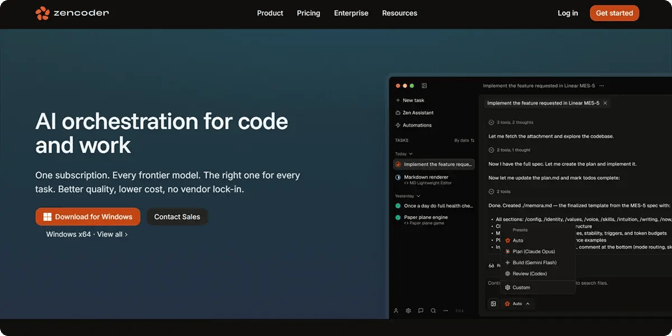
Zencoder approaches AI-assisted software development differently from traditional coding assistants by coordinating multiple specialized AI agents within structured engineering workflows. Through Zenflow, dedicated agents handle coding, testing, code review, refactoring, and verification tasks collaboratively, rather than relying on a single general-purpose model.
Key Features:
1️⃣ Zenflow – Zenflow is Zencoder’s AI-first engineering workflow engine designed to coordinate multiple AI agents inside structured development pipelines. Teams can:
- Execute feature development, bug fixes, and refactoring workflows
- Run tasks in parallel isolated environments without merge conflicts
- Enforce automated verification through testing and cross-agent reviews
- Build directly from specifications, PRDs, and architecture documents
- Keep implementations aligned with business and technical requirements
2️⃣ Autonomous AI coding agents – Traditional RPA bots are limited to repetitive workflows with predefined rules. Zencoder’s autonomous AI coding agents operate differently by understanding context, making decisions, and iterating toward successful outcomes. These AI agents can:
- Generate production-ready code
- Refactor legacy applications
- Review pull requests
- Detect logic and security issues
- Fix bugs automatically
- Iterate until validation passes
These agents operate with awareness of the broader codebase rather than working in isolation, making them more reliable for enterprise-scale engineering tasks.
3️⃣ Repo Grokking™ – One of the biggest limitations of traditional automation is the lack of contextual understanding. RPA bots typically execute tasks without understanding the systems they interact with. Zencoder’s Repo Grokking™ gives AI agents a deep understanding of:
- Repository architecture
- Internal workflows
- Custom implementations
- Service dependencies
- Engineering patterns across the codebase
This context-awareness enables agents to make more accurate decisions, generate higher-quality code, and reduce implementation errors, something rule-based automation cannot reliably achieve.
4️⃣ Zentester – Zentester automates testing across the entire application stack, from unit tests to end-to-end workflows. It can:
- Generate tests from natural language prompts
- Adapt tests automatically as code evolves
- Detect risky code paths and edge cases
- Interact with APIs, databases, and user interfaces
- Maintain test suites without constant manual rewrites
5️⃣ Multi-repository search – Zencoder can index and search across multiple repositories, allowing agents to work effectively in large-scale, multi-service architectures. Developers can manage repositories through a centralized admin panel, providing AI agents with a broader understanding of interconnected systems.
Try Zencoder for free today and go beyond rule-based automation with coordinated AI agents for coding, testing, and software delivery.

FAQ
1. What types of businesses benefit most from RPA and AI agents?
Businesses in industries such as finance, healthcare, retail, customer service, and IT can benefit from both technologies. RPA is ideal for repetitive administrative tasks, while AI agents are better suited for workflows that involve reasoning, communication, and analyzing unstructured data.
2. How do AI agents learn and improve over time?
AI agents improve through training data, feedback loops, and ongoing model updates rather than fixed programming rules. Their performance can become more accurate over time as they process more information and adapt to new patterns or business requirements.
3. Will AI agents replace RPA?
Not at all. RPA provides the structured foundation AI agents rely on, while AI adds flexibility and decision-making capabilities. Together, they create a more powerful hybrid automation approach for modern business workflows.